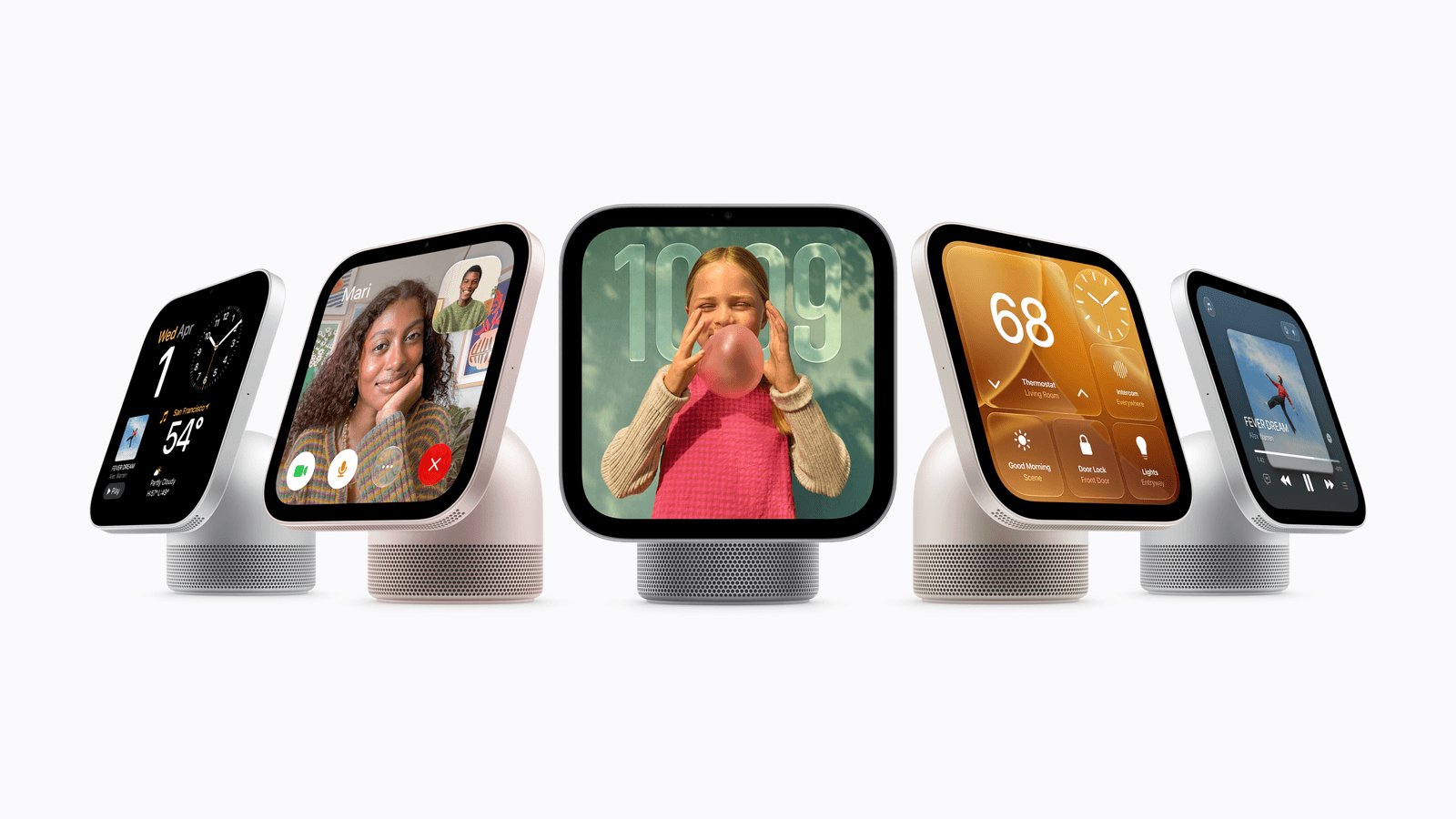
Apple finally has a smart display. HomeView is a $299, 7-inch Liquid Retina hub announced this morning at the company's "Welcome Home" event in New York, and it's the most interesting thing Apple has shipped for the home since HomeKit.
The aluminum unit comes in two versions at the same price: a tabletop model with a domed speaker base and a stainless steel tilt hinge, and a wall-mounted model. Tabletop colors are silver, starlight, rose pink, and space gray; the wall version is silver or space gray. Pre-orders opened today, with availability starting November 13. It's not for sale in the EU yet, because Siri AI still isn't available in iOS there.
Hardware is straightforward. An A18 chip, a 12-megapixel Center Stage camera, True Tone, and brightness that ranges from 500 nits down to 0.3 nits (handy for a nightstand). The tabletop base adds a down-firing woofer and two force-cancelling passive radiators; the wall model tunes audio for on-wall placement. Face recognition personalizes the screen for up to six people, and personal content in Messages and Calendar only shows when that person's face is recognized and their paired iPhone or iPad is nearby and recently unlocked.
Software is the bet. HomeView runs its own HomeView OS, not iPadOS, and there's no App Store — just a curated set of Apple apps plus some third-party audio/video and CarPlay apps. Glanceable "faces" borrow the Watch idea: clock, Photos, weather, even Snoopy. The Home Camera face can show nine live feeds at once. Siri AI is the main interface, with personal context pulled from a paired Apple Intelligence iPhone (15 Pro or newer, per WIRED). Setup needs a compatible iPhone or iPad on the latest software.
HomeView landed alongside a $149 HomePod mini 2 (S10 chip, ships October 30) and a $299 Apple TV 4K with built-in far-field mics (ships November 13), plus an Apple Home Collection of LG and Schneider accessories arriving from December. Amazon and Google have sold screen speakers for years. Apple is late, priced in the middle, and tying the whole thing to the iPhone. That's either the point or the limit.
— via Apple Newsroom, The Verge, WIRED.