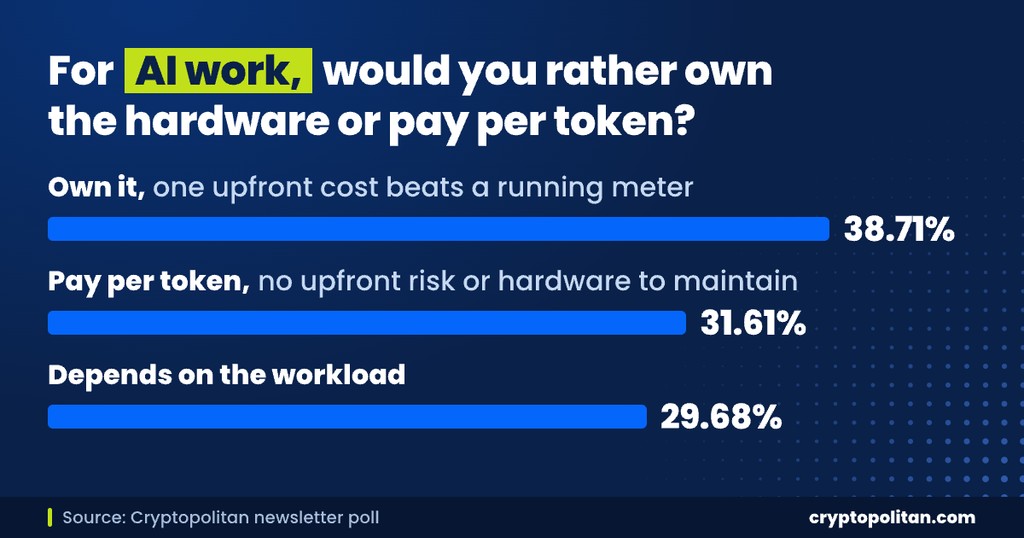
Apple's enterprise pitch for the M5 Ultra Mac Studio has a new data point, and it should worry Cupertino less than it flatters it. Cryptopolitan polled its newsletter readers today on the central question of Apple's "ditch the AI meter" argument — for AI work, would you rather own the hardware or pay per token? The result was a three-way split: 38.71% said "own it," 31.61% said "pay per token," and 29.68% said "depends on the workload."
The hook here is who was asked. This is a crypto-native audience — people whose instincts run toward self-custody and running your own node, the "not your keys, not your coins" crowd. If any audience was going to roar for owning the box, it was this one. That the "own it" camp couldn't crack 40% is the actual finding. Apple's running-cost argument — hardware chief Johny Srouji's line that "there's no cost per token, you're just using the machine again and again" — is persuasive, but not decisive.
And the pay-per-token camp had the week's facts on its side. Anthropic slashed Claude Opus 5.5 to $4 per million input tokens and $20 per million output — about a 20% cut — the same week Apple's new Macs started shipping on September 22. Roughly 90 minutes later, OpenAI answered with GPT-6 Sol and Luna at about half its previous price. Renting keeps getting cheaper, and the frontier models you rent are still more capable than anything you can download onto a $5,499 Mac Studio.
But the rental side's strength is also its tell. Gartner projects inference costs per agentic workflow will rise more than fivefold through 2028: cheaper tokens don't mean smaller bills when agents run longer, make more calls, and get handed more work. It's the taxi meter that never stops running, and everyone in this debate knows it.
Which is why the third of readers who refused to pick a side gave the engineers' answer. Steady, repetitive, high-volume jobs that run all day favor owning. Occasional, bursty work that needs the most capable model favors renting. Plenty of teams will end up doing both — cheaper open models on local iron for routine work, frontier APIs for the hard problems.
Step back, and this is no longer an Apple-vs-OpenAI debate. Microsoft's Satya Nadella is already pitching on-device AI as "unmetered intelligence," and the October 7 Windows event in San Francisco put a $5,999 Surface RTX spark dev box on the table alongside the $2,599 Surface Laptop Ultra — with Asus, Dell, HP, Lenovo, and MSI all opening pre-orders for their own RTX spark machines, per Cryptopolitan's report. The local-AI desktop is becoming a platform fight, and Apple is waging it with 4.6% of the enterprise desktop market against Windows' 91.3%, according to IDC data cited by Reuters.
So the per-token era isn't dying — it's being hedged. The money for an entry M5 Ultra Mac Studio buys hundreds of millions of tokens at OpenAI's new rates, a long runway for one developer and a few weeks for a company running agents around the clock. The smart money isn't choosing a side. It's arbitraging both.
— via Cryptopolitan