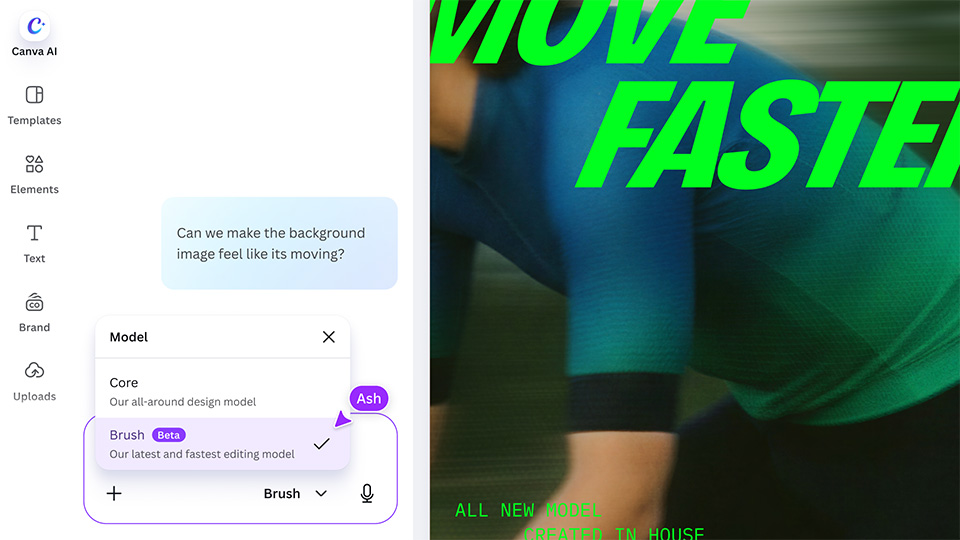
On Thursday, Canva introduced Brush — its second in-house AI model in a week, and this one doesn't draw. It edits, according to The Letter Two.
Brush is a vision-language model trained on design itself: it reads a layout's structure, layers, and visual style, then works through changes step-by-step the way a human designer would. Ask for a new color scheme or a deck-wide header swap, and the model writes and runs small pieces of code to adjust the design, inspects the result, and decides what to do next. Every element it touches stays fully editable afterward.
The pitch is the antithesis of the generator era. Ask today's image models for one small edit and you tend to get a domino effect — the typo gets fixed and the background catches fire. Canva's framing, in its announcement: "The model needs to understand what you want to change, how the design is structured, and just as importantly, what needs to stay exactly as it is." That constraint is the product.
But the economics are the actual story. Canva says Brush completes editing tasks up to 69% faster than its previous design agent, at 46% lower cost per task — the company's own figures, from internal testing, with no independent benchmark published. Why build a bespoke model for work general-purpose models can technically do? Because when hundreds of millions of people make billions of designs, a few cents per edit compounds into real money. Canva slowed its AI rollout earlier this year precisely because the math wasn't ready; Brush is the answer.
The training recipe is vertical to the point of being proprietary. Canva Research, the company's 160-person AI lab, started from an unnamed leading open-weights model, then trained it further on real design and editing tasks — drawing on in-house design expertise, the template library, opted-in anonymized user insights, and "hundreds of thousands" of simulated edits scored on visual quality, design principles, and task completion. Professional designers on staff, per Canva, set the bar for what counts as good.
It lands a week after Canva Craft, the company's first image-generation model — the one Canva says trails only OpenAI on DesignArena's rankings. The division of labor is the strategy: "Craft generates the image, and Brush refines the design around it." Adobe reached the same conclusion last year with Firefly Image 5's layered editing, but Adobe edits individual images while Brush works across whole designs — a single line of copy to every slide in a deck.
Brush is in beta for Canva Pro subscribers, with wider availability promised. Brand Kit support and attachment references are already on the roadmap. The announcement video passed 2.2 million views on X, per Fast Company — a sign that design-slop fatigue is real. Canva's bet is that the next AI gold rush isn't generating more content. It's fixing what everyone already made.
— via The Letter Two