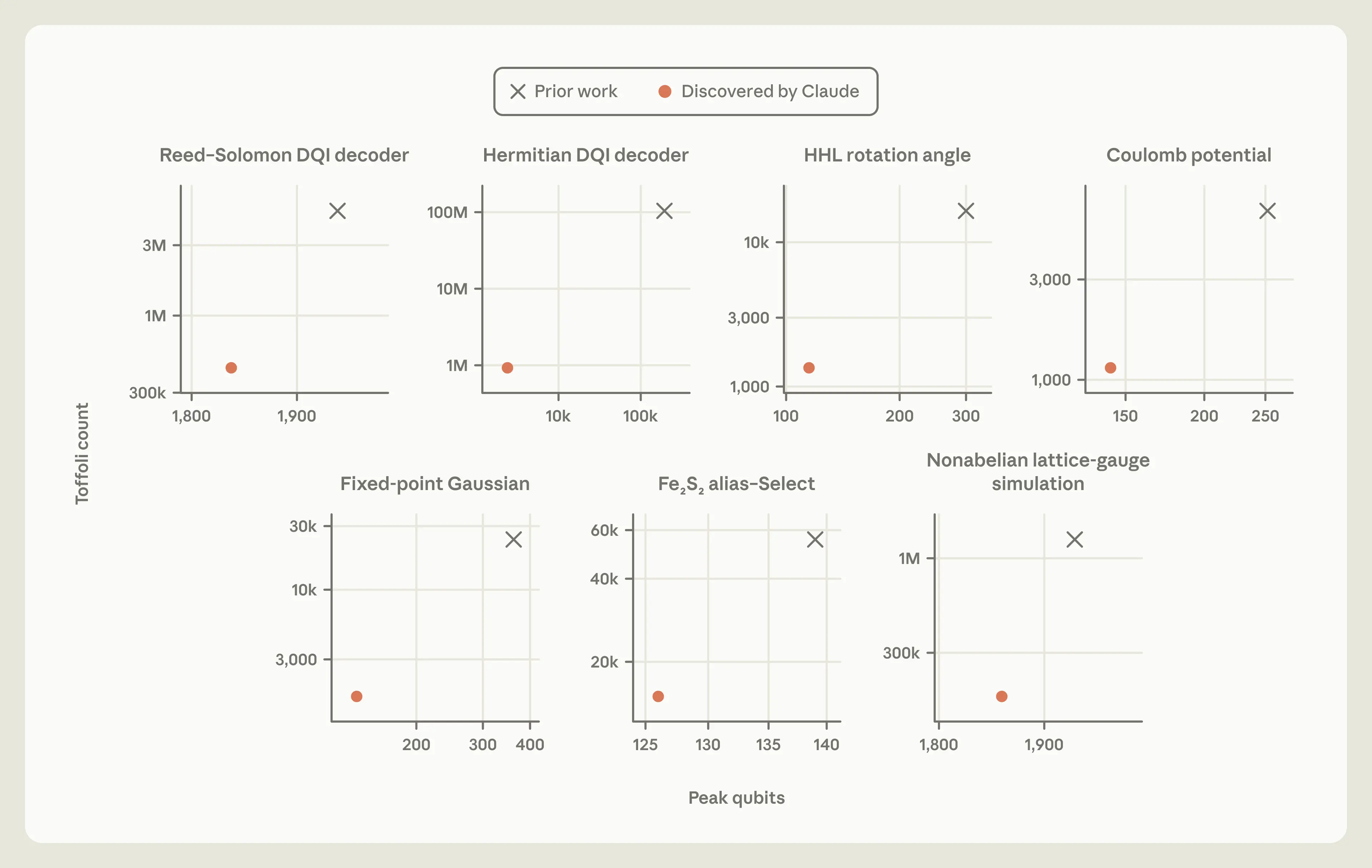
Anthropic turned its own model on one of quantum computing's hardest engineering problems, and it came back with designs no human had found. In research published Friday, the lab says Claude Mythos 5 designed quantum circuits for eight computational primitives that beat the best previously published versions — in some cases by an order of magnitude or more.
The setup was a closed loop: Claude got plain-language descriptions of eight circuits from chemistry, optimization, simulation, and number theory, plus an evaluator scoring qubit and gate counts. Then it worked largely alone — 53 hours from a one-paragraph brief for the headline result, a new approach to elliptic-curve point addition.
The wins came from new math, not tweaks. According to Anthropic, for point addition — the core step in quantum algorithms for the elliptic-curve discrete logarithm — Claude derived new algebraic identities and produced the first reversible implementation of the divsteps algorithm, recovering branch history from the numbers themselves. One design in the family uses 12% more qubits but 17x fewer gates than the smallest previous design, verified in Lean. On a second task, the most expensive step of the DQI optimization algorithm, it swapped the extended Euclidean algorithm for Berlekamp–Massey decoding and ran 403 million sample decodings through a simulator it wrote itself — discovering the circuit needed to save only one exceptional value (19 qubits, not a worst-case 665). That decoder runs 12x cheaper than Google's prior construction.
Why it matters: in quantum computing, gates are errors. Each gate is a chance for noise to corrupt the computation on machines with only hundreds to thousands of qubits, so an order-of-magnitude gate reduction is the gap between an algorithm that runs on real hardware and one that doesn't. Human researchers spent eight years driving the gate estimate for simulating a nitrogenase enzyme from 50 trillion to 340 million. Claude's elliptic-curve result came from a single weekend run.
The caveats are stated plainly: the circuits are computationally verified, not run on physical hardware, and Claude needed prodding — it "repeatedly second-guessed apparent improvements" until the team forced parallel exploration of novel ideas. But the properties that made circuit design a good fit — expressible as code, checkable for correctness, scoreable by cost — apply equally to error-correcting codes and hardware control. Anthropic floats AI optimizing all of them jointly, from algorithm down to hardware — and with that, the AI labs end up doing fundamental science, not just shipping chatbots.
— via Anthropic