Your Signal messages have always rested on math. Now they rest on a proof — more than six million lines of it, written by AI.
Google DeepMind announced AlphaProof Code on November 10, an agentic framework that formally verified the code underlying the Signal protocol — the encryption behind billions of conversations. Formal verification, mathematically proving code does what it claims, is the highest standard of security assurance, and DeepMind says this is the first time AI has verified a widely deployed protocol at this depth, and the first time any method has verified the implementation, not just the design.
Researchers have formally analyzed protocol designs for decades, but most real-world flaws hide in the gap between design and shipped code. AlphaProof Code closed it, proving the compiled code delivers the specified protections down to the machine instructions — including forward secrecy and post-compromise security, so messages stay protected even if a device is compromised.
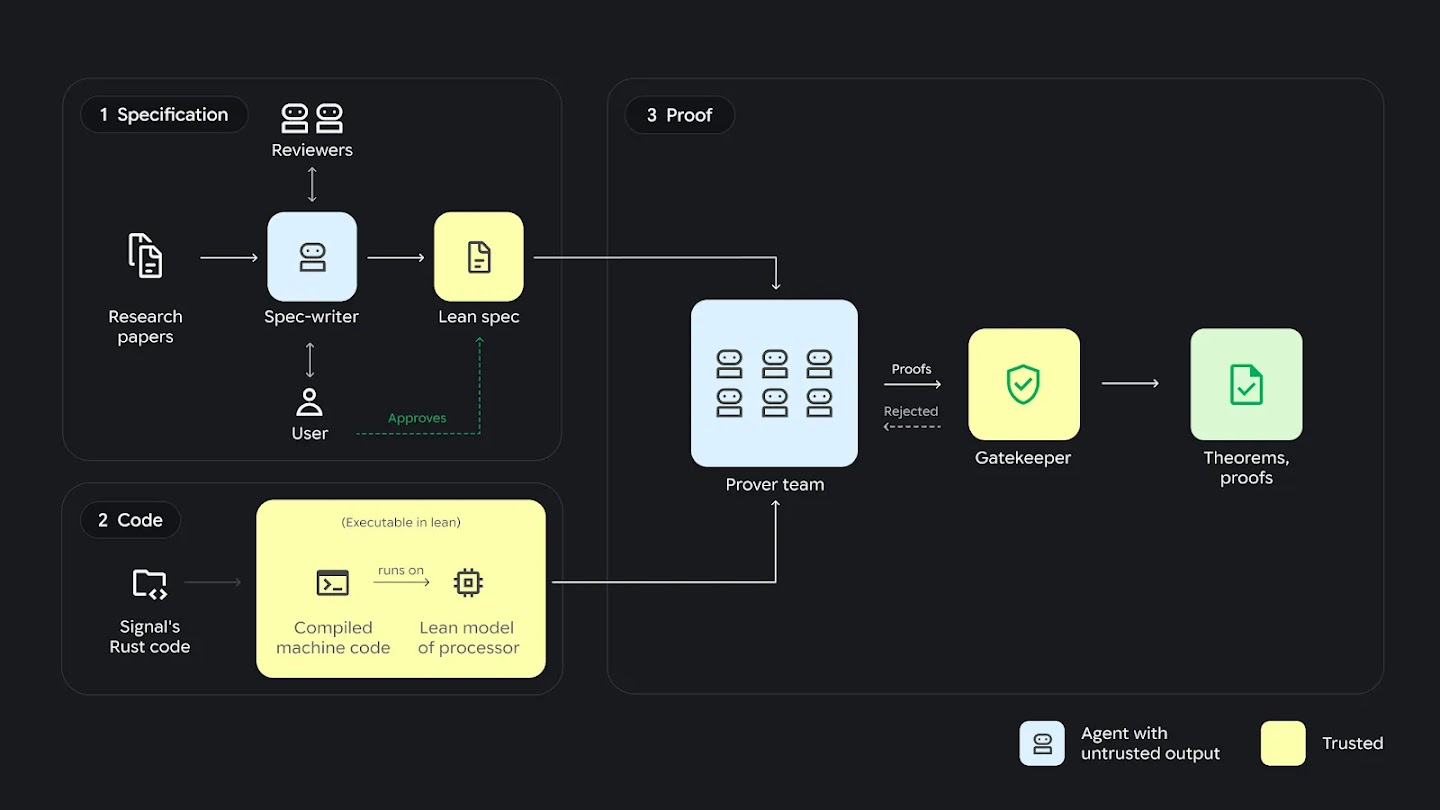
Human experts worked with models to turn Signal's security goals into formal Lean specifications, reviewing every one; then Gemini Carbon agents wrote the proofs and audited their own work, flagging one percent for a second human look. Four weeks in total — a job DeepMind says would historically take expert teams years.
DeepMind also tested whether the system can tell good code from bad, reintroducing two real, previously fixed bugs into an isolated copy of Signal's code — in both cases it produced a machine-checked proof the buggy version was insecure.
Signal's CTO Ehren Kret called the work "a great breakthrough," saying that "having the core Signal protocol rigorously verified with automated theorem proving gives us even greater confidence that our code delivers on its privacy guarantees."
The scope has limits. The proof covers one-to-one sessions — the PQXDH handshake and the Triple Ratchet — under stated assumptions. Group chats, key generation, and multi-device state sit outside it, and the roughly 26,000 lines of trusted specification are the part humans still have to read: a proof is only as strong as the spec it proves.
DeepMind has open-sourced the verification artifacts and frames Signal as the first target, not the last: the same techniques could secure medical device firmware and power grid software. The other side is already moving — AI agents find vulnerabilities at machine speed. The defense is finally learning to move at the same speed, and to bring receipts.
— via Google DeepMind