Drug discovery has a data-wrangling problem disguised as a science problem. According to a Google DeepMind blog post published November 3, chemists still spend most of their time on the grunt work — curating structures from papers, patents, and vendor catalogs — because the same molecule can appear as an IUPAC name in one paper, a Markush structure in a patent, and a structure-data file in a catalog. DeepMind's answer is Cheminformatics Skills for Google Antigravity: an agent layer that turns the platform into what it calls "a collaborative science workbench."
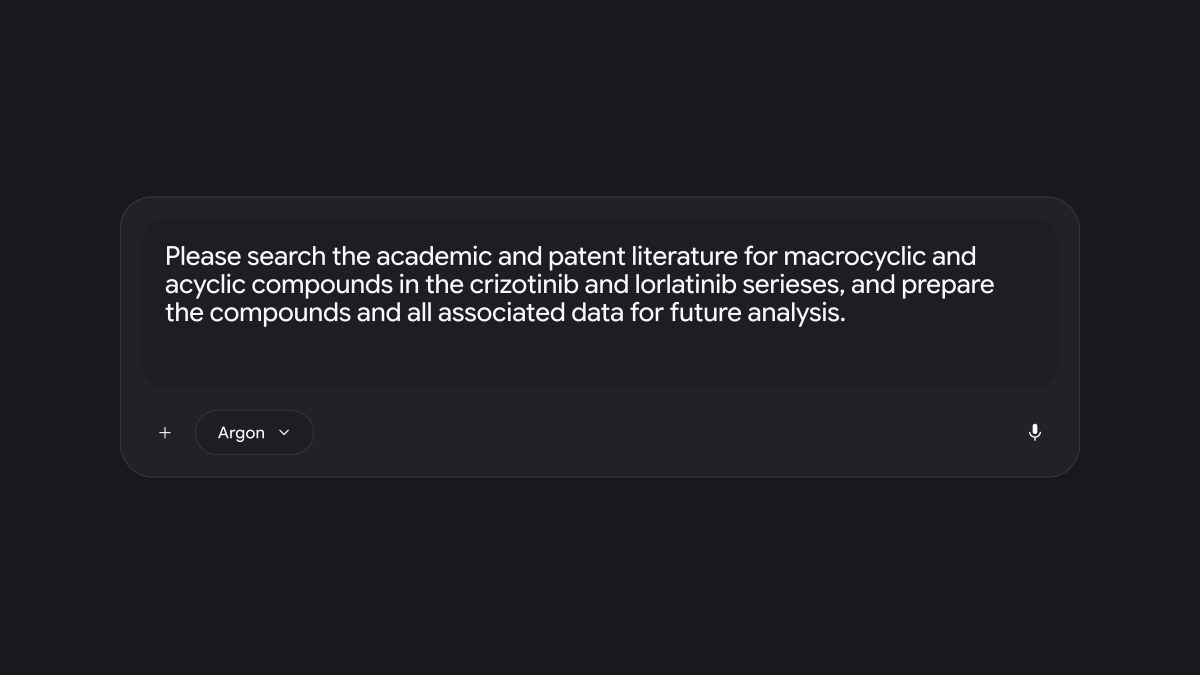
The demo is the interesting part. DeepMind picked a case medicinal chemists know well — rigidification, the trick of locking a floppy molecule into its active shape to boost potency. Crizotinib, a first-generation lung cancer drug, has five major rotatable bonds; lorlatinib, the third-generation follow-up, cyclized the structure down to zero and gained potency. The agent searched the literature for both series, pulled thousands of compounds in minutes, filtered out junk like buffers and solvents, and plotted potency against rotatable bonds in an interactive viewer. Then it ran matched molecular pair analysis and trained potency prediction models — suggesting the analysis itself, DeepMind says — before proposing new macrocycle designs with suggested synthesis routes. One hour, a workflow that normally takes days.
The architecture is worth noting because it's the industry pattern: the language model handles orchestration, database navigation, and scientific reasoning, while deterministic tools — grounded in the open-source RDKit toolkit with connectors to ChEMBL and PubChem — do the actual molecular math. The agent never computes a molecule; it asks the tools to.
And DeepMind is admirably blunt about the limit: "computational designs are testable hypotheses, not finished drugs." None of the proposed molecules have been synthesized or validated. That's the right framing — this is accelerated hypothesis generation, not a drug.
Watch next: the distribution play. The skills are live now in the Antigravity app with a Science plugin, and DeepMind is offering the highest usage tier free for six months to 10,000 scientists. If even a fraction of those researchers pipe their real pipelines through an agent and publish what comes out, the next year of medicinal chemistry papers will tell us whether this was a demo — or a discipline changing.
— via Google DeepMind