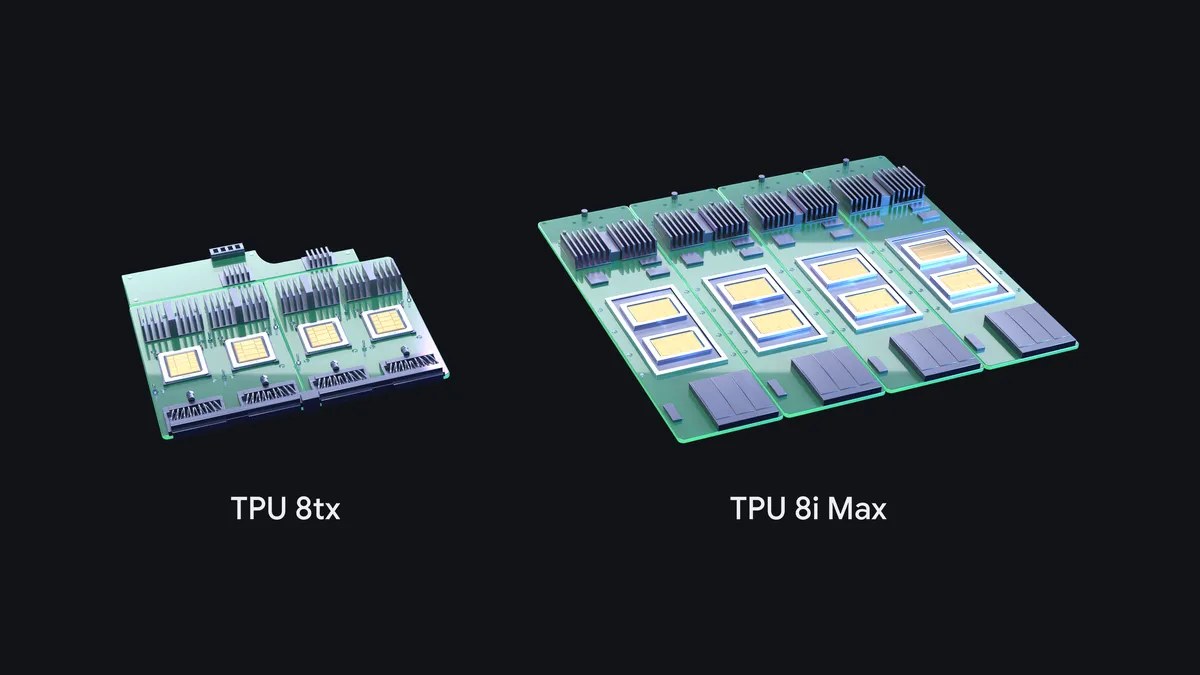
Google didn't announce a new chip today. It announced something more threatening to Nvidia: a pace Nvidia can't match.
The two new systems — TPU 8tx and TPU 8i Max, unveiled Monday on Google's blog — are the third and fourth eighth-generation TPU systems Google has shipped this year, after the 8t and 8i debuted at Cloud Next in April. Google says it's the first time it has introduced four TPU systems in a single year, and the speed is the point: neither is new silicon. The 8tx is built on the same silicon as the 8t, and the 8i Max is two existing 8i chips fused into one package. Google's modular, building-block design lets it reconfigure its accelerators in months, while a brand-new chip takes years.
Each system is aimed at one of the two problems enterprises actually have now. The 8tx is for confidential inference: paired with fifth-generation AMD EPYC hosts, it keeps sensitive data and model weights encrypted and isolated even while they're being processed — the pitch for banks, governments, and regulated industries running agents on their most sensitive data. Google claims up to 2x lower latency than the 8t. The 8i Max is for the memory wall: doubling the compute, SRAM, and HBM bandwidth of a single 8i, it targets the massive context windows that dozens of agents chewing through a whole codebase or hours of video demand, packed into the same rack footprint.
The customer list is what turns this from a product update into a market story. Google says TPUs now have nearly 100 customers, from frontier labs to trading firms and retailers, and Bloomberg reports the roster includes Apple, Meta, Oracle, and Anthropic — with OpenAI reportedly planning to buy in, too. Bloomberg Intelligence estimates Google's TPU-related sales could top $135 billion by 2028, up from about $12 billion this year, with TPUs priced roughly 30% below Nvidia's GPUs.
Two caveats, and they matter. Neither system ships yet — Google's Amin Vahdat told Bloomberg both arrive in 2027 — and there's no published pricing, no full spec sheet, and no independent benchmark. Every performance number so far is Google's own.
Still, the direction of travel is unmistakable. A decade ago TPUs were Google's private infrastructure. Today they're a business with a four-system-a-year cadence, an open PyTorch stack, and a customer list that reads like Nvidia's. Jensen Huang has spent years insisting nobody else can do this at scale. Google just spent one year proving it can.
— via Google