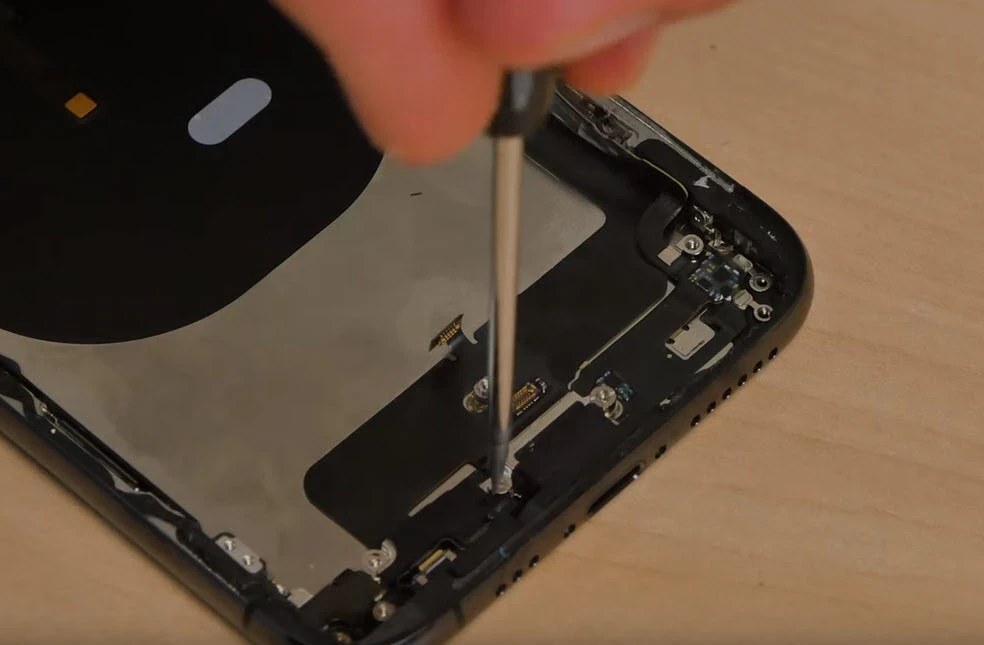
The iPhone Duo goes on sale today, and it's already in pieces. The first teardown of Apple's foldable, carried out by YouTube channel Kingmi Mobile and reported by Gadgets360, answers the question that's shadowed the device since launch: how did Apple make the crease so subtle? The answer is less "engineering breakthrough" and more "really good camouflage."
Peel off the matte, nano-textured cover layer and the inner display underneath is glossy — looking much like the Samsung Galaxy Z Fold 8's — and the crease becomes noticeably more prominent. The minimal crease isn't a structural property of the Duo's display stack; it's a property of a replaceable film sitting on top of it. To be fair, Apple isn't hiding this: hardware engineering chief Kate Bergeron said in an interview earlier this month that the layer was designed to be replaceable as it wears, built to last as long as possible. The catch is that the film's job includes the crease, so when it degrades, the crease comes back into view — an aesthetic part that doubles as the phone's signature optical illusion.
This reframes the crease conversation from "did Apple solve it?" to "how long until you pay to re-hide it?" A damaged film costs Rs. 5,900 to replace in India — pocket change next to the Rs. 1,49,900 price of a new inner display — but it's still a wear item on a $1,999 device, and Apple advises owners not to peel it off themselves. Combined with stress tests showing the crease deepening after thousands of folds, the film may be doing a lot of the long-term heavy lifting.
Inside, the repairability report is mixed. There are batteries in each half of the body, as expected — but reaching them requires removing both the rear panel and the secondary screen, a more involved job than a standard iPhone battery swap. The teardown also calls out thin, folded ribbon cables connecting components like the selfie camera to the mainboard, delicate enough to raise the risk of accidental damage during disassembly. On the brighter side, both selfie cameras, the dual rear camera system, and the mainboard can each be replaced individually rather than as a fused unit. The hinge and the folding inner display are the exceptions: they're deeply integrated, making them the most time-consuming repairs — which is exactly where the eye-watering service prices land.
What to watch: how the matte film actually ages in real pockets and hands over months, whether Apple eventually publishes a replacement cadence for it, and whether independent repair shops treat the film swap as a routine job. Apple has turned the crease from an engineering problem into a maintenance item — and maintenance items have a price.
— via Gadgets360