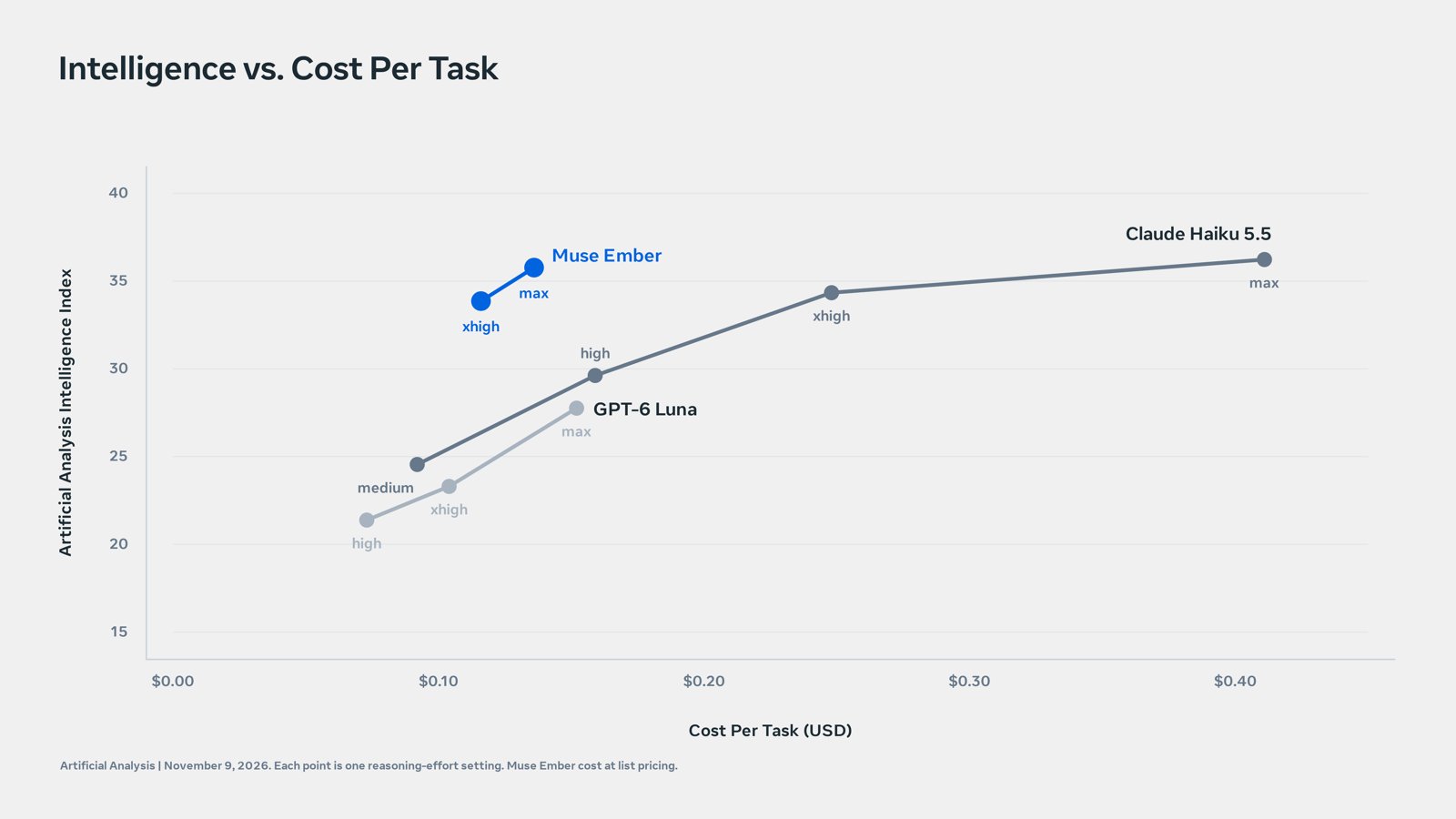
Meta is done competing on who has the smartest model. On Monday, its Superintelligence Lab released Muse Ember, the smallest and cheapest model in the Muse family — and the pitch isn't capability, it's cost per task. At $0.10 per million input tokens, according to TechCrunch, Ember is built for the work AI agents repeat all day: tool calls, coding subtasks, routing, extraction, and long document parsing.
Nobody runs an agent once — a support agent applies the same rules across tens of thousands of cases. Meta's answer is a division of labor: pair Ember with a bigger model that does the thinking, and let the cheap one do the volume. "Muse Wonder plans, Muse Ember handles the volume," the company said.
Meta backed the pitch with a benchmark it chose on purpose. Using Artificial Analysis's composite score, the company claims Ember delivers more intelligence per dollar than Anthropic's Claude Haiku 5.5 and OpenAI's GPT-6 Luna — about $0.14 per task, versus roughly $2.39 for its own mid-weight Muse Spark 1.3. Those are Meta's numbers, and the comparison is doing heavy lifting: Ember isn't trying to beat the frontier models at reasoning, it's trying to make their price look silly for everything that doesn't need it.
The spec sheet fits the job. Ember carries a 1 million-token context window, can return up to 512,000 tokens in a single response, and accepts text, images, audio, and video natively — so agents can read screenshots and scanned documents or work from voice memos without a second model. It's available as `muse-ember-1.0` through Muse Code and the Meta Model API, as well as Google Cloud and Oracle Cloud. It's the fourth Muse model in seven months, after Spark in April, its open-weights twin Glimmer in August, and the frontier Wonder in October.
Watch what happens next. First, whether Anthropic and OpenAI answer with their own volume-priced small models, or cede the cheap end and keep charging flagship prices for work that never needed a flagship. Second, whether Ember's "more intelligence per dollar" claim survives contact with real agent workloads — benchmarks are a pitch, and the repetitive middle of an agent loop is where models quietly fail. If it holds, the most consequential model Meta shipped this year might be the one it priced like a rounding error.
— via TechCrunch