Taiwan's first semiconductor strike ended before most of America woke up. The argument behind it isn't going away.
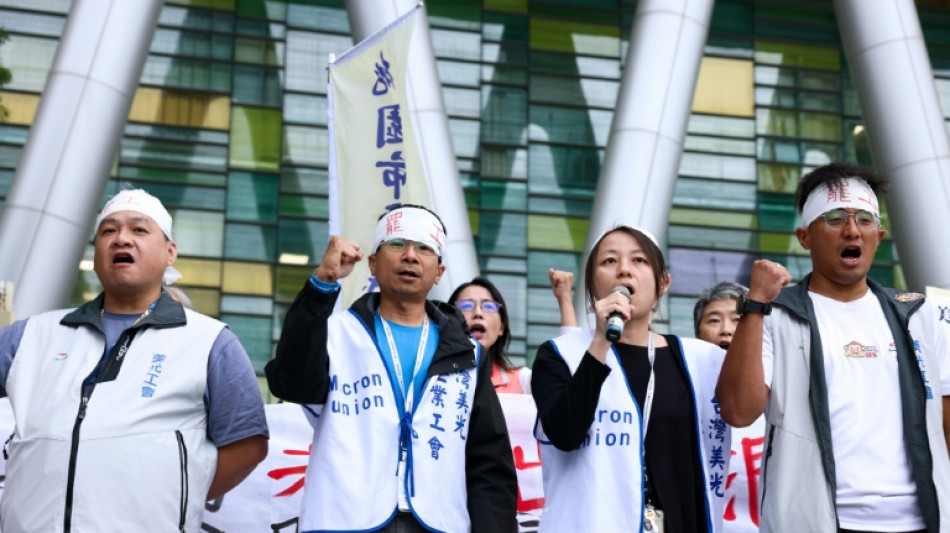
Workers at Micron's Taoyuan DRAM plant began a 24-hour walkout at 9 a.m. Thursday local time — a stoppage that Nikkei Asia reports is the first strike ever in Taiwan's semiconductor industry. It was small: Taiwan's Central News Agency counted 11 union officials at the start, and an AFP photographer captured five workers outside the plant holding a banner that read, "Micron failed to propose a profit-sharing scheme. The Taoyuan union will immediately begin strike action."
Small, but aimed at the biggest margin pool in tech. The union wants a permanent system paying workers 15 percent of operating profit, distributed quarterly, instead of the one-time bonus Micron offered last month — the equivalent of up to 68 months' pay, which workers rejected. The union's opening position was an 83-month one-off payout plus the permanent 15 percent cut, according to AFP's reporting.
Micron Taiwan chairman Lu Dong-hui called the strike "regrettable" but said the company remains "fully committed to continuing sincere communications with them." It did just settle the bigger prize: the Taichung union, representing about 12,300 of Micron's roughly 15,000 Taiwan employees, signed a labor-management agreement Wednesday that moves to a quarterly profit-sharing bonus system with a bigger pension contribution. Taoyuan's chairman, Jerry Lin, called that deal "unilateral" and said his union "strongly condemns" it — the Taoyuan workers were never consulted, and Taichung was asked to sign a confidentiality agreement. "If you give up, that's when the game is over," Lin said.
The resentment is personal. Hsu Fun-ting, a 45-year-old engineer who has worked at Micron for 26 years, told AFP she was "quite disappointed": "We are all employees of Micron Taiwan, yet the company signed an agreement only with the Taichung union, and even made them sign a confidentiality agreement. I don't think that's how the company should be acting."
The backdrop is why this matters beyond one fab gate. Micron makes roughly half to 60 percent of its chips in Taiwan, and its DRAM and high-bandwidth memory are the bottleneck components in AI servers. The memory shortage is the entire bull case: the stock closed Wednesday at $913.67, a $1.03 trillion market cap, up more than 200 percent this year. Samsung already averted its own semiconductor strike by agreeing to bonuses worth 10.5 percent of operating profit. Taoyuan wants 15 — and if one fab's warning shot becomes the industry benchmark, the AI boom just acquired a labor bill.
— via AFP