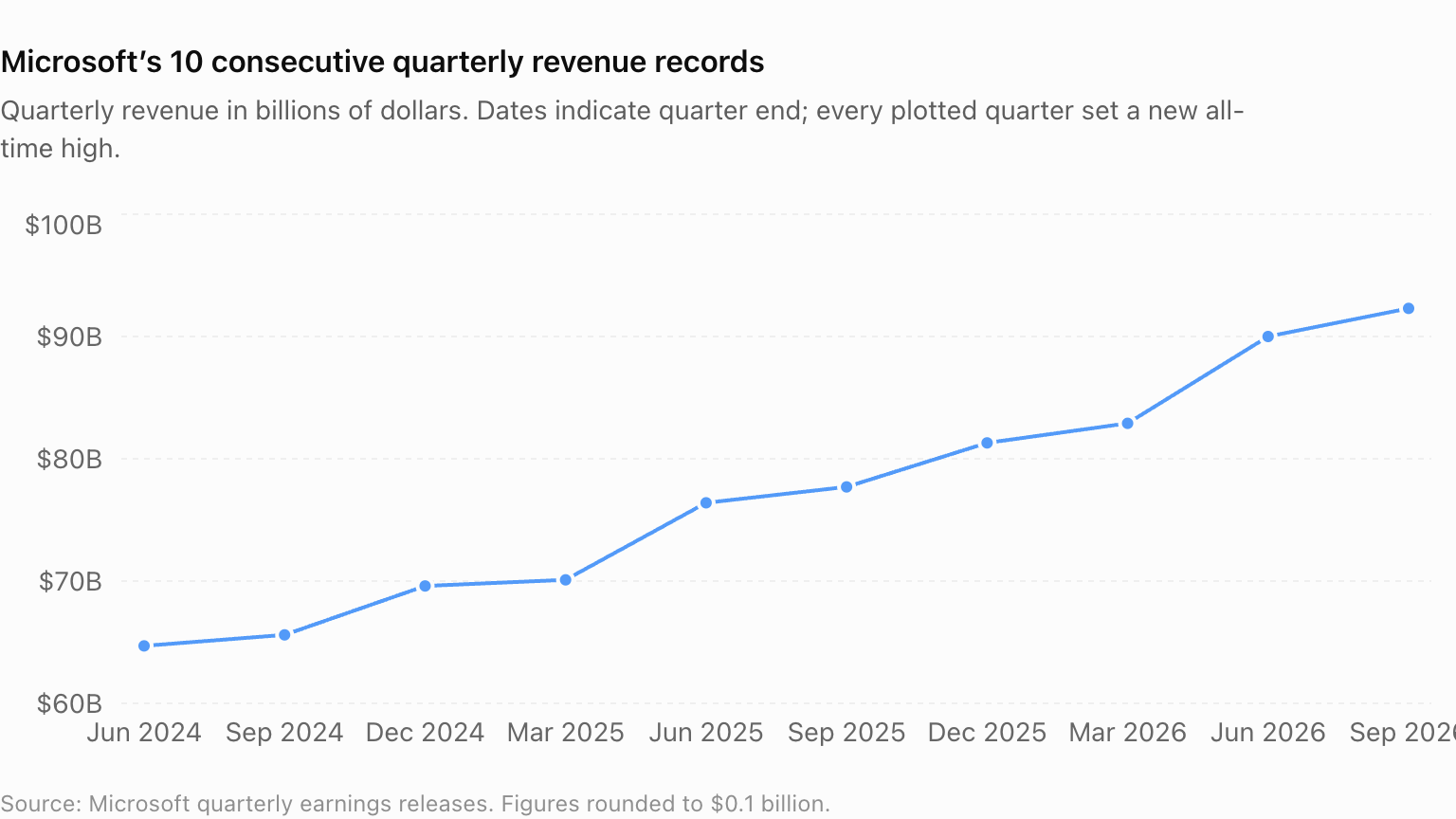
Microsoft's $92.3 billion quarter got all the headlines on Wednesday — ten straight quarters of record revenue, Azure up 48%, the works. But the number that actually explains where the AI money flows was sitting quietly in the 10-Q notes: Microsoft booked $10 billion in revenue from its commercial arrangements with OpenAI in the quarter ended September 30, according to TechCrunch, which first pulled the figure from the filing.
That's roughly 11% of Microsoft's entire quarterly revenue, from a single customer. For context, $10 billion in three months exceeds what Microsoft gets from Xbox, or from Windows PC licensing, in the same period. And the pace is accelerating: OpenAI-related revenue hit $24.1 billion across all of fiscal 2026, meaning the current run rate is roughly double last year's full-year figure. On top of it, OpenAI owed Microsoft $7.2 billion in outstanding receivables at the end of September, up from $6 billion three months earlier — a balance-sheet footnote that says a lot about who holds the leverage in this relationship.
The honest read is that Microsoft disclosed this because it had to — OpenAI is a related party under accounting rules, since Microsoft holds roughly a 24% stake on an as-converted basis, down slightly from 25% in June. The filing language covers both revenue-sharing payments and Azure services, and Microsoft doesn't break out how much of the $10 billion is rent for compute versus the revenue-share deal that Reuters has reported at 20% and that runs through 2030.
Still, the shape of the loop is unmistakable: Microsoft has paid in over $12 billion of its committed $13 billion-plus investment in OpenAI, OpenAI committed to another $250 billion in Azure services under the October 2025 agreement, and a tenth of Microsoft's revenue now comes back the other way. This is the same circularity the site flagged when Nvidia and AMD bought $4 billion of Meta's own shares — the AI boom's biggest customers and its biggest investors are increasingly the same names, just rotating positions.
What to watch next: whether Microsoft ever splits out revenue-share from Azure spend, and whether the receivables line keeps climbing. Amazon reports after the close today — and its AWS disclosures will say a lot about whether this concentration is a Microsoft quirk or the industry template.
— via TechCrunch