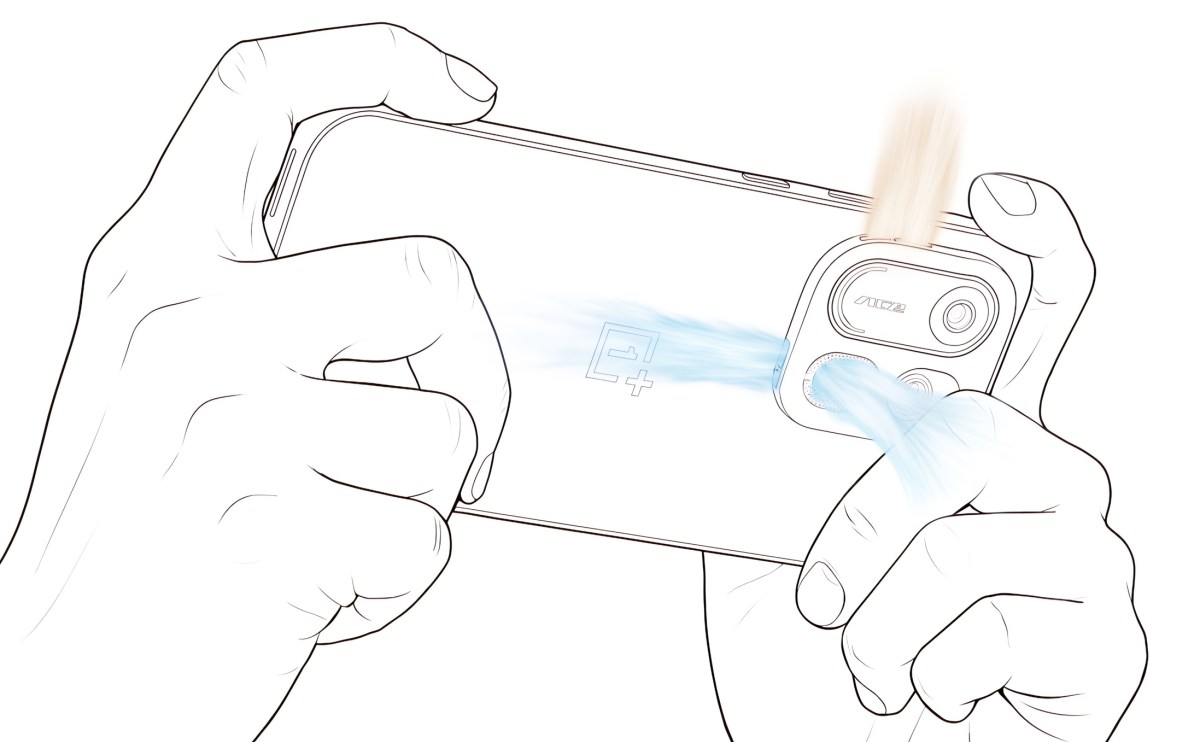
For years, the phone industry's answer to heat was physics: shrink the transistor, spread the load, throttle quietly and hope nobody notices. OnePlus has decided to skip the subtlety. Ahead of the Ace 7 series launch in China later this month, OnePlus China president Li Jie has spelled out the design of the lineup's built-in active cooling fan — two airflow paths, integrated into the phone itself.
The layout is more considered than "fan goes in, heat goes out." One stream blows across the chipset and vents hot air through the side of the device. A second stream passes cool air over the rear panel, aimed at the very human problem of sweaty hands during long gaming sessions. The intake sits where your fingers don't when you hold the phone in landscape, and the hot exhaust goes upward, away from your grip. It's industrial design in service of a simple thesis: peak benchmark numbers are meaningless if the phone can only hold them for four minutes.
That thesis may already have receipts. Leakers Digital Chat Station and Ice Universe reported this week that the Ace 7 Pro held a native 185 fps in Delta Force at high settings — while an unnamed phone running a newer 2nm flagship chip managed only 165 fps in the same scene, according to GizChina's account of the posts. Unverified, but if anywhere near true, it's a remarkable admission about where performance actually comes from in 2026: not the node, but the thermals.
Phone fans are hardly new — RedMagic has been spinning one for generations, and ASUS sells clip-on coolers for the ROG line. What's notable is a major brand making active cooling a headline feature of a mainstream performance lineup instead of a niche gaming toy. The Ace 7 and 7 Pro are rumored to pair the Snapdragon 8 Elite Gen 5 with a 200MP camera and a 9,000mAh battery — a spec sheet that already reads like it was built to sustain, not sprint.
There's a catch, and it's a big one for anyone reading this outside China: you probably can't buy one. OnePlus announced in July that it was withdrawing from Europe and the United States, and the Ace line is expected to stay in China (with a likely India rebrand as the OnePlus 16R). So the most interesting hardware idea in phones this year is also the one its former fans can't have — which, given OnePlus built its name on not settling, is a fittingly ironic place to end up.
— via GSMArena