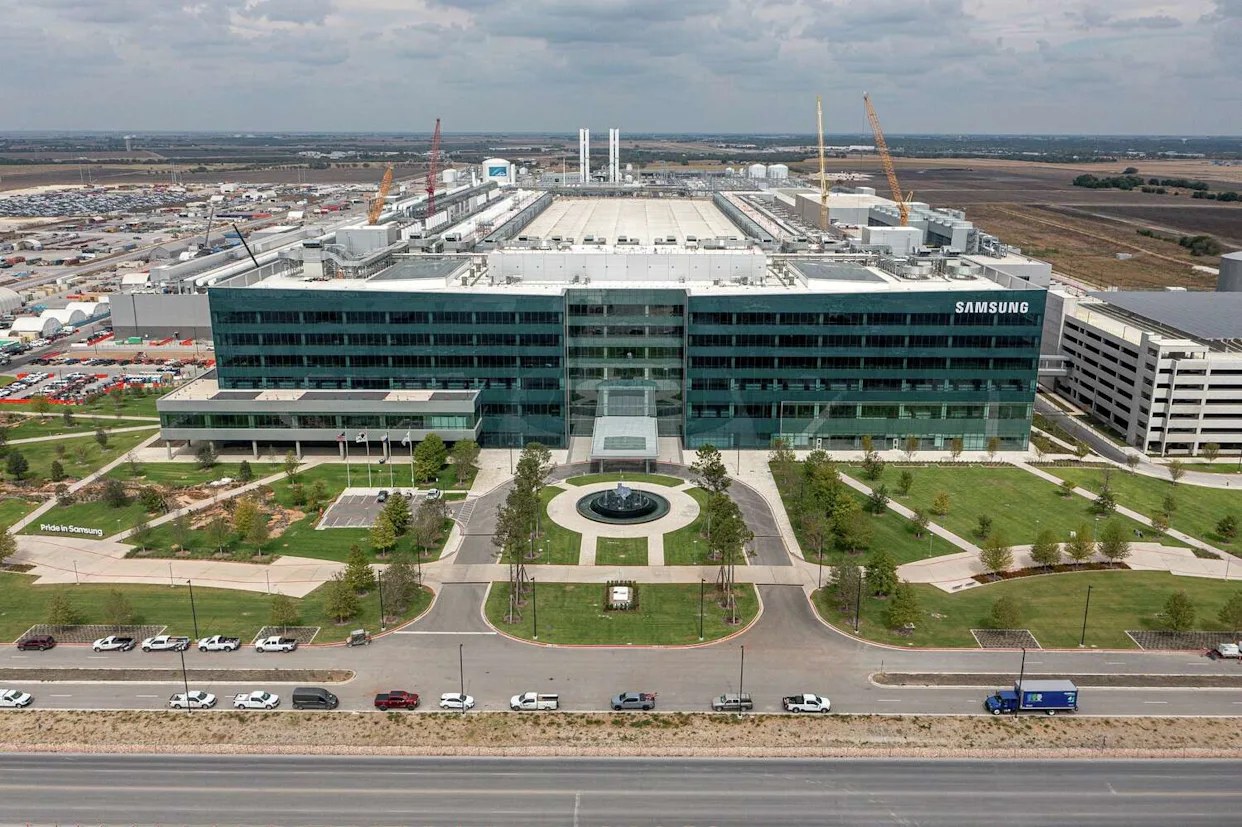
Samsung is about to break ground on a chip plant that already has no room left. Its second foundry in Taylor, Texas will produce the base dies for high-bandwidth memory (HBM) chips used by AMD and Nvidia, Reuters reported Tuesday, citing South Korea's Maeil Business Newspaper. Formal construction starts this month — and the plant has reportedly secured orders for its entire output, with most of the volume going to AMD.
The details are striking for a facility that won't ship a chip for years. At roughly 2.7 million square feet, the second fab will be about 1.5 times the size of Samsung's first Taylor plant and will use 2-nanometre technology. Equipment installation is expected from February 2029, with mass production targeted for 2030. Samsung declined to comment.
The base die is the least glamorous but most strategic part of the HBM stack: it's the logic layer that sits beneath the stacked DRAM and handles the traffic between memory and processor. Samsung reportedly plans to make the base dies in Texas and pair them with DRAM core dies from its South Korean fabs — splitting HBM production across two continents, with the final-mile work landing in the United States.
Why it matters: this is the onshoring story the AI industry keeps promising but rarely pre-funding. Samsung's first Taylor plant is anchored by Tesla, whose $16.5 billion deal (signed July 2025) covers next-generation AI chips. Add AMD and Nvidia to the second, and Samsung's Texas campus becomes a three-customer, US-based supply chain for the memory and logic behind AI accelerators — exactly the kind of resilience the Trump-era tariff and export-control era has been demanding.
The timing also says something about the HBM crunch. Samsung's South Korean rival SK Hynix just told investors its record-profit run is backed by a memory shortage stretching to 2030. Meanwhile TSMC is eyeing a 20% price hike on advanced packaging, the other bottleneck. AMD and Nvidia are locking in base-die capacity in Texas four years ahead of production — a bet that today's AI-memory tightness isn't a cycle but a decade.
Watch next: whether AMD's reported majority share of the plant's output signals a deeper push into AI accelerators, and whether Samsung's competitors — Micron, which is building its own US fabs, and SK Hynix's Indiana plant — start announcing similarly pre-booked capacity. In a market this tight, the real product is the reservation.
— via Reuters