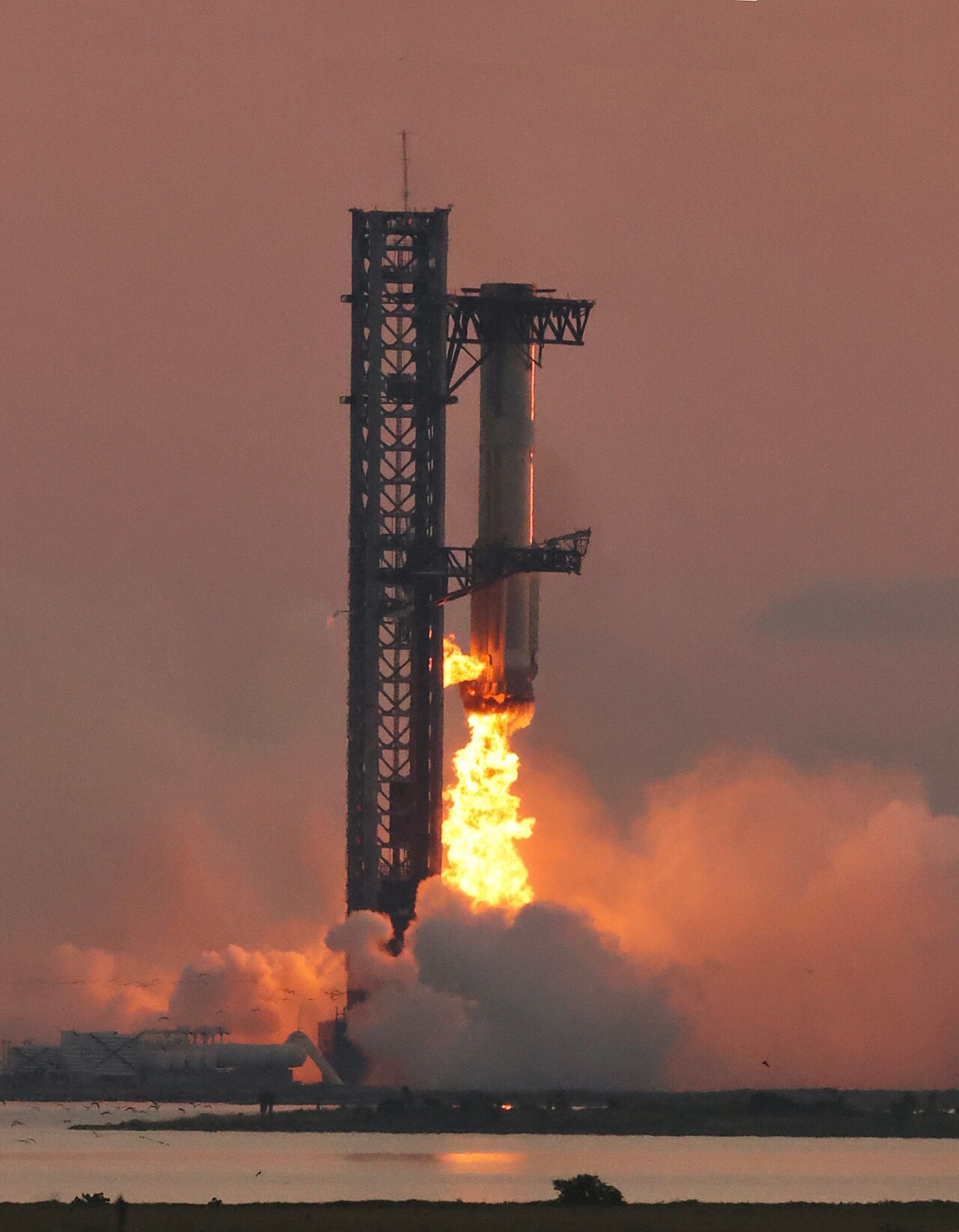
Friday the 13th was supposed to be a two-rocket day. ULA scrubbed Vulcan this morning, so the evening belongs entirely to SpaceX — and its most ambitious test flight yet is still missing one piece of paperwork. Starship Flight 15 opens its 75-minute launch window at 5:45 p.m. ET from Starbase, Texas, but SpaceX still hadn't received its FAA launch licence as of Friday morning, according to Reuters, and the agency didn't respond to a request for comment.
This flight is genuinely new: for the first time, SpaceX will try to catch both stages of the 407-foot rocket. Booster 22 should fly back to the tower's mechanical arms minutes after liftoff — a trick SpaceX has pulled off three times, most recently in March 2025. The hard part comes later: Ship 42 spends roughly 22 hours in orbit, circles Earth 14 times, then attempts the first-ever catch of an upper stage, expected around 2:45 p.m. CT Saturday. SpaceX has called a successful double catch a "breakthrough moment in making Starship a reliable, rapidly reusable rocket."
Nor is this a test flight for its own sake: Flight 15 carries 26 Starlink V3 satellites, the second Starship mission to fly an operational batch — both a revenue flight and a proving run. Its predecessor reached orbit for the first time on September 28, deployed 26 of the same satellites, and splashed down after about three hours — a shortened version of a planned ten-hour mission.
The countdown's groundwork looks ready even without it: road closures around Starbase were set to begin at 11 a.m. local time, and airspace notices are filed through November 19, so a slip of a few days would be contingency, not cancellation. The FAA has typically issued Starship licences a day before launch — which is what makes Friday morning's silence worth watching, not panicking over. Still, every hour without one narrows the margin.
The stakes extend past tonight. Musk expects a weekly Starship cadence by the first half of 2027, and SpaceX says it could launch from a new Florida pad by year's end. NASA has delivered roughly $3.2 billion toward Starship as its Artemis moon lander, with SpaceX putting at least $15 billion of its own money in, and the two still expect a crewed lunar landing by 2028 — a date analysts consider optimistic while orbital fuel transfers remain unproven. Catching both stages in one flight is the step that makes any of that schedule plausible. First, though, somebody at the FAA has to sign.
— via Reuters