Warehouse robotics has a dirty secret: the hardest part of the warehouse isn't the machines, it's the boxes. Every SKU arrives with a different shape, weight, and crushability, and every time the inventory changes, somebody has to recode the robot. Tutor Intelligence thinks it can skip that step entirely — and on Monday it raised $75 million in an Andreessen Horowitz-led Series A to prove it, with Union Square Ventures and Neo joining the round.
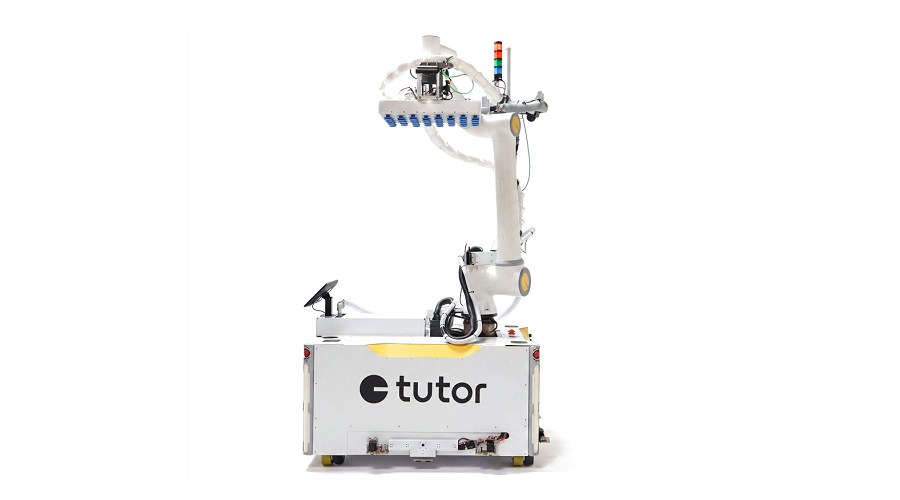
The company's pitch comes in two robot flavors. Cassie is a mobile arm on a four-wheeled platform that loads and unloads pallets, moving up to 18 items a minute with a vacuum gripper rated for more than 50 pounds. Sonny is the more interesting one: a wheeled robot with a pair of arms that picks items off shelves and packs them, using time-of-flight and stereo cameras for depth perception. Tutor says it teaches Sonny new tasks the way you'd train a person — a human expert demonstrates the job on a remotely controlled robot in a facility that hosts more than 100 of them, and the AI learns by imitation.
That detail is the whole bet. "Data collected by our Sonny fleet trains our largest and most capable robot foundation models at the frontier of rate and reliability," co-founder and CEO Josh Gruenstein wrote in the announcement. It's the Tesla playbook applied to warehouses: every deployed robot is a data collector, and every demonstration makes the whole fleet smarter. If it works, programming a warehouse robot stops being an engineering project and starts being an apprenticeship.
The market timing is friendly. Tutor says the number of facilities running its robots nearly quadrupled in the past year, and it sells on a usage-based model that removes the six-figure upfront purchase — the classic move to get warehouse operators to say yes faster. It's the same physical-AI wave that just pulled $50M into Formic's loading-dock automation: investors are done funding robots that need programmers, and are paying up for robots that learn.
The new funding goes toward better AI models and faster robot production. The open question is how well imitation learning holds up against the long tail of warehouse chaos — crushed corners, shrink-wrapped oddities, the 3am inventory surprise. Tutor's fleet will find out quickly enough, because every shift is now a training run.
— via SiliconANGLE