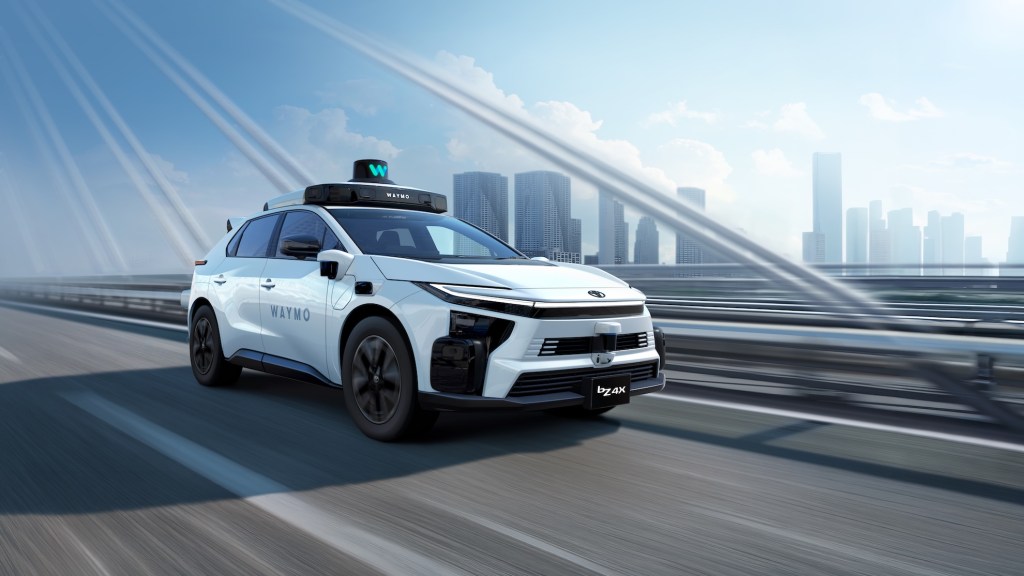
Waymo finally found a car company willing to build its robotaxis the way cars are supposed to be built — on an assembly line.
Toyota and Waymo announced Friday that they will put Waymo's autonomous driving system inside the 2027 Toyota bZ4X, with the base vehicle and the self-driving hardware coming together at Toyota's Takaoka plant in Toyota City, Japan. Test and validation of the fleet starts in Japan in 2027, with deployment to the UK and other Waymo-served markets planned for the following years, according to TechCrunch. Toyota calls it a milestone toward Japan's first fully autonomous ride-hailing service using high-volume, domestically manufactured vehicles.
The factory detail is the real news. Until now, Waymo has bought finished cars — Jaguar I-Paces, Zeekr SUVs — and retrofitted its sensors and computers afterward. Here the hardware goes in under one roof alongside the base vehicle. That is a manufacturing commitment, not a demo fleet, and it is exactly the scaling problem every robotaxi operator has to solve before the economics work.
The fine print stays small. Neither company disclosed financial terms, fleet size, Japanese cities, or when commercial rides begin. Hiroki Nakajima, Toyota's executive vice president and a board member, told reporters the first fleet will involve "a small number of vehicles." Waymo co-CEO Dmitri Dolgov told Reuters the rollout starts where the steering wheels are: "We'll start with the right-hand drive markets in Japan and the UK."
The timing also matters. Eighteen months ago this partnership was a vague agreement to "explore" — the kind of press release that usually goes nowhere. Now it is a supplier deal with a vehicle, a factory, a market, and a date. That evolution mirrors how the whole autonomous industry is maturing: the differentiator is no longer the demo, it is production at scale.
There is a second thread buried in the announcement worth watching. The companies said they will "continue to look at" bringing Waymo's autonomous technology to personally owned Toyota vehicles. Nothing concrete yet — but it would make Toyota the first legacy automaker to ship consumer cars with someone else's self-driving system inside, and it explains why Toyota is bothering to learn factory integration in the first place.
The near-term test is London. Waymo has been running Jaguar I-Paces there for months and plans to launch service once it secures permits under the UK's Automated Passenger Services framework. If the Takaoka line works, the bZ4X becomes Waymo's standard international platform — and its fleet problem starts looking like a production schedule instead of a retrofit headache.
— via TechCrunch