Google's XR strategy just grew a wire. XREAL Aura, launched with Google as the first wired glasses powered by Android XR, opened for orders on October 28 at $1,099, with US shipments starting in mid-November and orders in Japan opening November 2.
The headline spec is what Aura doesn't weigh. The glasses come in under 95 grams because, as Google's XR chief Shahram Izadi put it, "the heavy processing happens in a portable compute puck, connected by a cable." The puck holds the battery and the debut of Qualcomm's Snapdragon Reality Elite platform — high-performance spatial computing offloaded so the glasses stay light enough to wear on a plane.
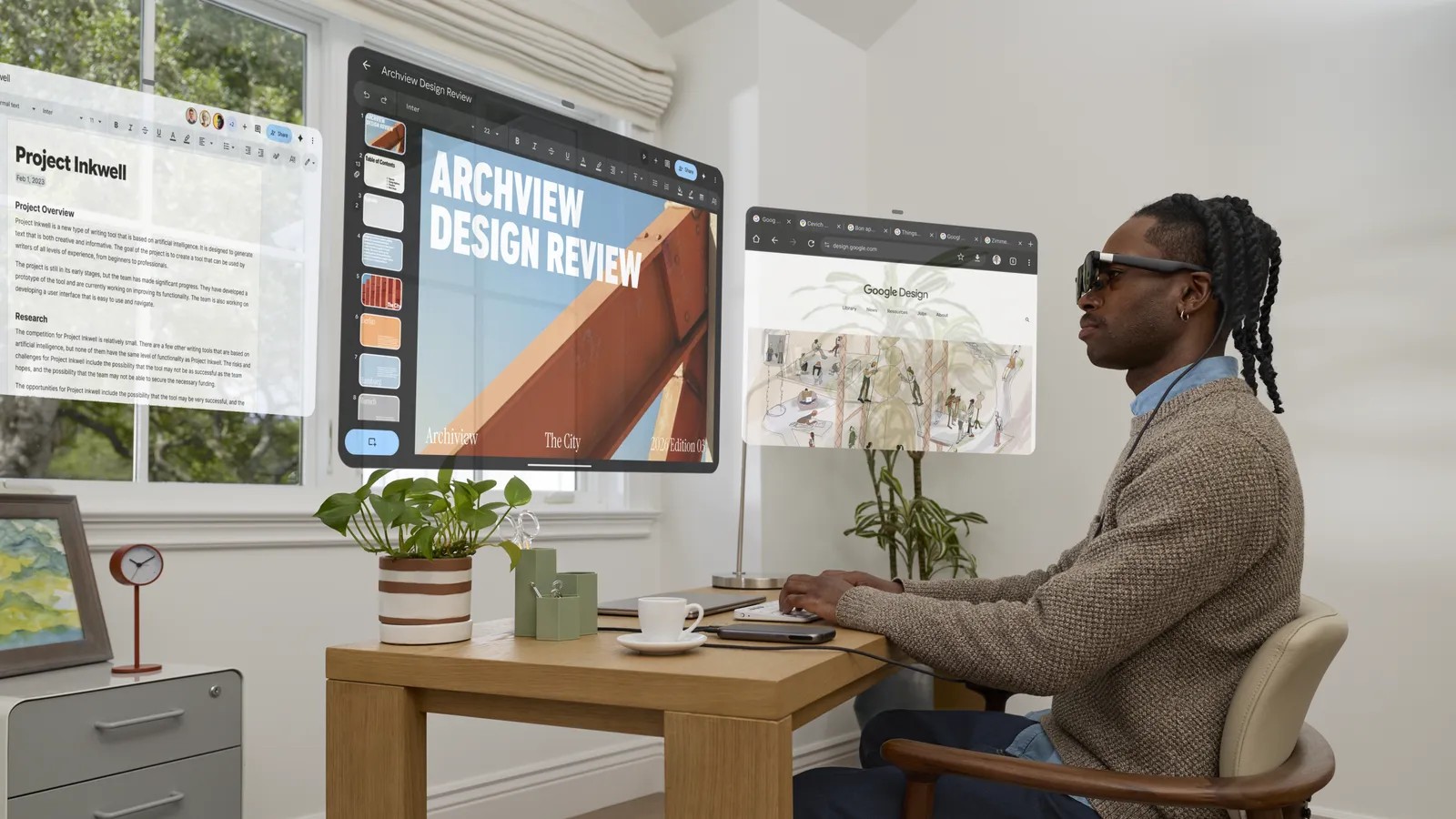
That's a philosophical bet, not just an engineering one. While Meta and Apple chase all-in-one headsets, Google and XREAL are arguing that the near-term consumer XR product is a display you wear, powered by a puck you pocket. The lenses are transparent with a 70-degree field of view, they dim for video and snap back to transparent when someone walks into view, and a feature called Wired Mirroring puts a laptop's screen in front of you over a USB-C cable — no software installed, invisible to the person in the next seat, which is the most compelling privacy pitch a pair of smart glasses has ever had.
Gemini is the software story: it sees both the room and your screens, so it can highlight what to focus on when you share your view. Android XR brings millions of Play apps plus over 150 made-for-XR titles, Bluetooth keyboard and mouse pairing or the puck as a trackpad, and hand-tracked games from Owlchemy Labs and Resolution Games — with Fallout Factions and Project Hail Mary: Journey Among the Stars arriving at launch. Immersive films land with the hardware too: "Nevatars," co-directed by Andy Serkis, and "Galapagos: the Last Eden," narrated by Margot Robbie.
The context worth noting: this is Google's Chromebook playbook applied to XR — partner-built hardware, Google's OS and Gemini — and it's XREAL, not marquee partner Samsung, that got Android XR glasses out first. At $1,099 through year's end, Aura is priced less like a moonshot and more like a very good monitor you wear: the pitch is a multi-monitor desktop from a couch or a tray table.
What to watch: whether anyone actually wants a wired computer on their face in 2026 — and what Samsung's own Android XR headset does to Aura's price once it finally ships. Orders are live at xreal.com and, in the US, Best Buy, for customers 18 and up.
— via Google