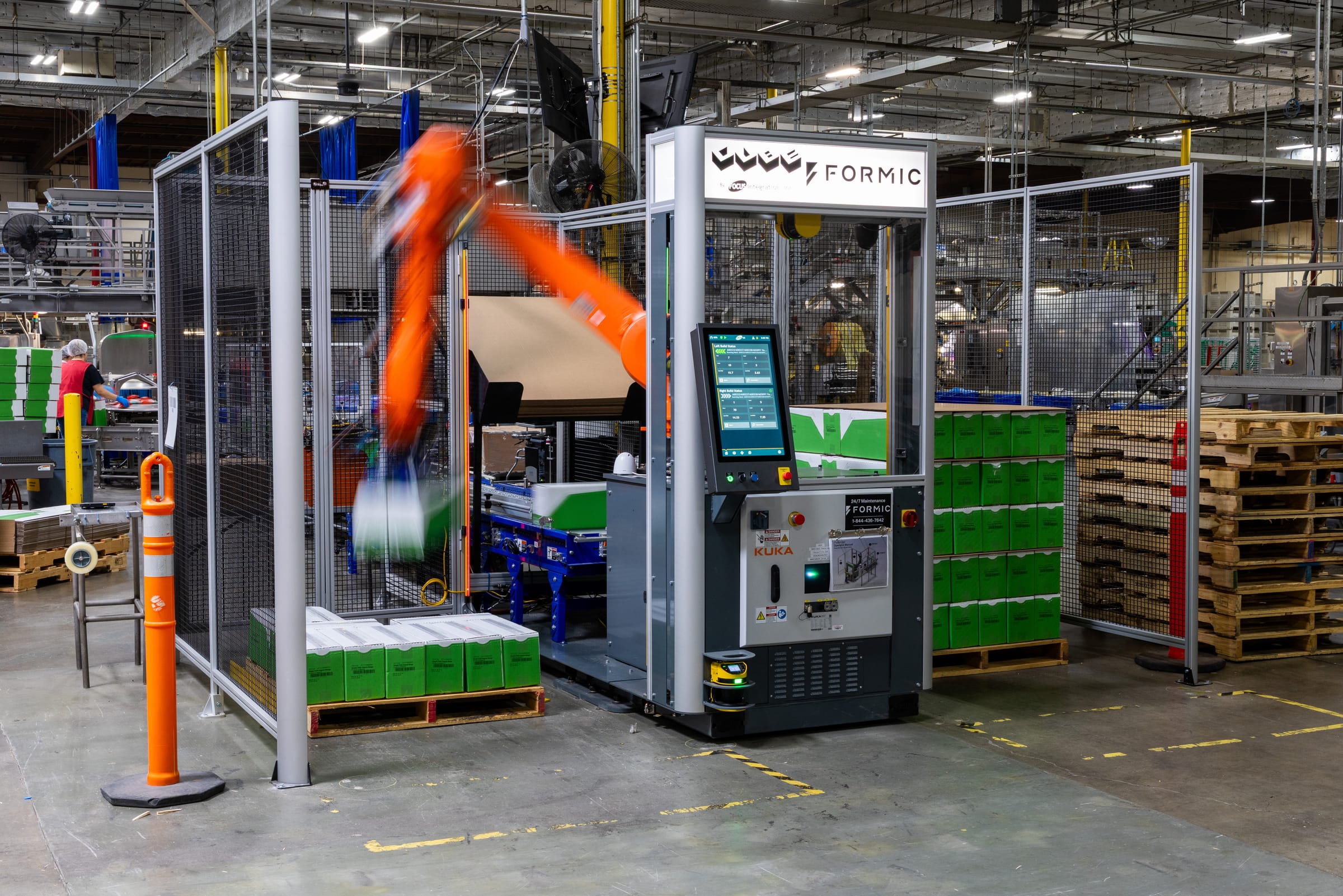
While the physical-AI money has been chasing humanoid demos and ever-more-dexterous grippers, Formic has been quietly building the most boring — and possibly the most important — layer of the whole industry: the deployment layer. The Chicago startup announced Wednesday it has raised $50 million in growth capital, including a Series B led by Mercato Partners and debt financing from S2G Investments, according to Business Wire.
The headline isn't the round. It's the operating record underneath it. Formic runs hundreds of robots across more than 100 facilities in over 30 states, with more than 750,000 hours of live production logged. Fleet uptime is 99.6%. The number that should make every humanoid startup jealous: 97% of customers renew. As VentureBeat noted, these aren't demo cells — they're palletizing, case packing, machine tending, and kitting systems earning their keep in food, beverage, chemicals, aerospace, and defense plants.
Formic's model is Robot-as-a-Service in the most literal sense: equipment, deployment software, field operations, maintenance, financing, and performance monitoring for one flat monthly payment. Zero upfront capital. For mid-market manufacturers, it removes the two things that have always blocked automation: the capex hit and the integration risk.
The new money funds a pivot from task-specific automation to general-purpose robotics — and here's the part that matters. Formic is working with Physical Intelligence, combining its robotic foundation models with Formic's production data. The foundation-model labs are coming to the fleet operator, not the other way around. Every robot in Formic's fleet generates data on tasks, operating conditions, and corrective actions, and the company now deploys systems roughly three times faster than it did a year ago.
"The robotics industry has made extraordinary progress in what robots can do. But building a capable robot and making it productive in a real factory are two very different challenges," said Saman Farid, Formic's founder and CEO. Mercato's Ryan Sanders, who joins the board, put the thesis more bluntly: "As robots get smarter, the bottleneck moves from the lab to the loading dock: deploying, servicing and financing robots in real plants."
What to watch: whether general-purpose systems can match the reliability record of Formic's single-task fleet, and how quickly the company pushes into metal fabrication plus aerospace, medical, and energy. Capability demos get the headlines. Deployment records get the renewals.
— via Business Wire