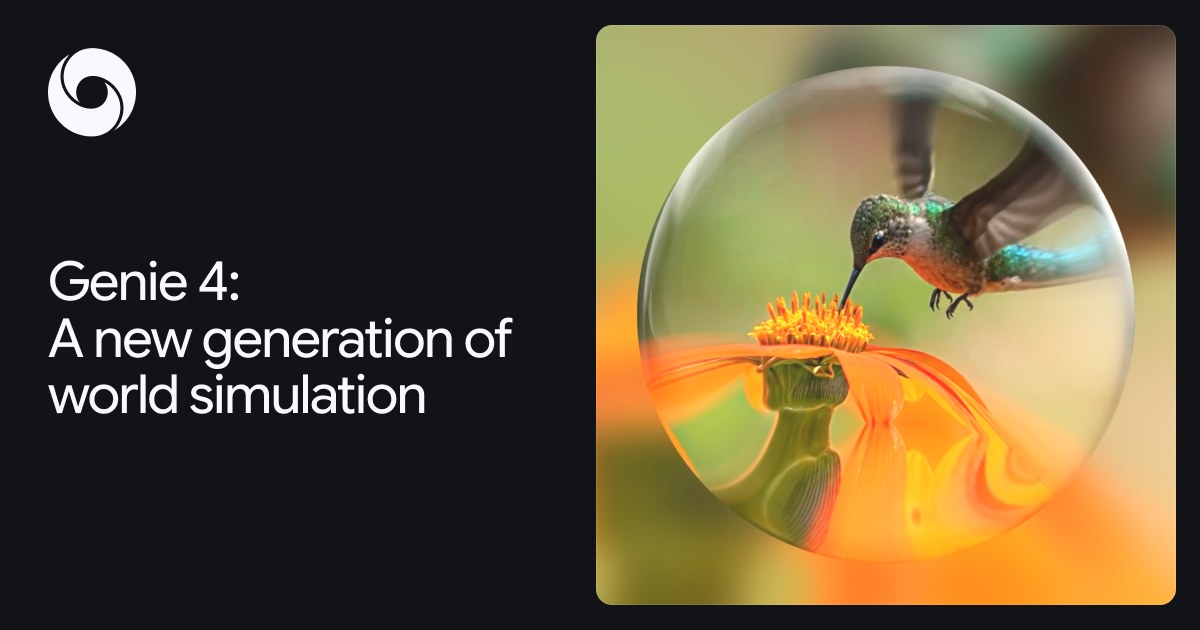
Google DeepMind has a new trick for its world models: this time, the world answers back.
Genie 4, announced today, generates explorable, photorealistic worlds in real time from a text prompt or an image — and for the first time, it generates the sound at the same time. Music, ambient noise, and characters who hold a conversation are all produced natively as the scene runs, according to Google DeepMind. The beach comes with waves. The people in it react when you speak to them.
That is a bigger shift than it sounds. The first three generations of Genie were silent films: impressive, but you watched them. Genie 4 turns the world into something you can direct mid-take — type a prompt to change the weather, swing the camera, or drop a new character into the scene, and the simulation keeps running while Gemini rewrites your instruction to fit what is already on screen.
Under the hood, Gemini is doing two jobs. Gemini Omni anchors how things look and behave, and Gemini 3.8 Flash acts as a guiding agent inside the loop, watching each frame, breaking goals into steps, and checking that each step actually happened. DeepMind even paired it with Gemini 4 Argon to simulate Apptronik's Apollo humanoid playing checkers — a preview of the real prize here, which is training robots and agents in worlds that cost nothing to break.
The scenes hold together for about two minutes — roughly double Genie 3's limit, according to reports on the launch — and DeepMind is candid that drift is still the enemy: details and object permanence can slip over longer sessions, and legible text and spatial accuracy remain works in progress. Every clip it makes carries a SynthID watermark.
For now it is a research preview for trusted testers, with Google AI Ultra subscribers in Project Genie and Gemini API partners next in line. The filmmakers and game developers testing it already see the use case: pre-visualization where you can run another take without rebuilding the set.
The longer game is the one DeepMind states plainly. Worlds you can walk through, talk to, and rewrite on the fly are the cheapest possible rehearsal space for the machines that will eventually have to operate in the real one.
— via Google DeepMind