The most expensive poem in computing history costs about $0.000012 worth of inference — plus one satellite.
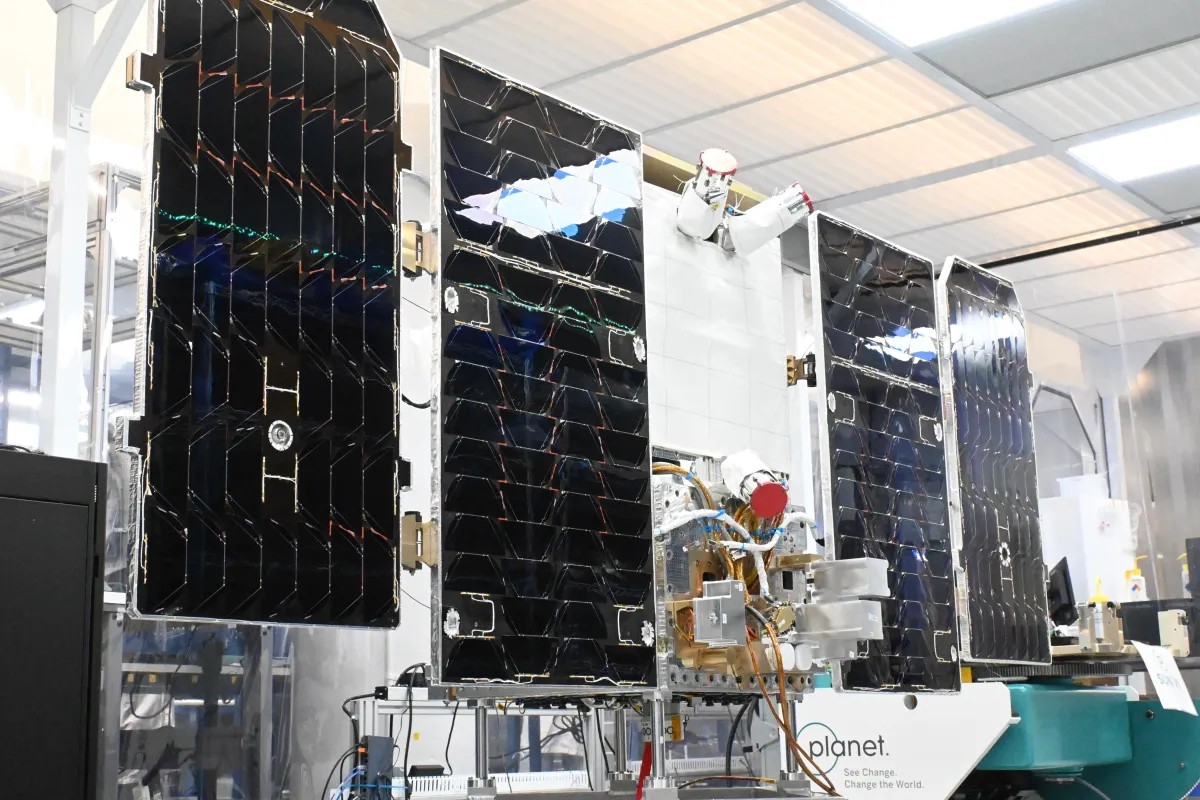
Google said Friday that its Project Suncatcher prototype satellite has completed its first "hello world" milestone: engineers uplinked a prompt during a ground-station pass, the onboard Gemma 4 model ran on a data-center TPU in low Earth orbit, and the answer came back down over Svalbard, Norway, reading:
Blue marble below,
Data streams in silent grace,
Starlight feeds my core. ✨
Travis Beals, senior director of Google's Paradigms of Intelligence research team, announced the milestone in a blog post on Google's site. "During a ground-station pass, we uplinked our first prompt to our onboard Gemma 4 open model, asking it to generate a haiku about being in space," Beals wrote. The actual prompt, per The Register, asked for the haiku "from the perspective of a TPU orbiting Earth, with the wonderful world spinning beneath you." Afterward, Google said it moved on to space-themed limericks and prompts that asked the model to report telemetry on the payload's own systems.
Behind the poetry is a survival test. The satellite, launched October 1 aboard a SpaceX Falcon 9 alongside more than 100 other spacecraft and built in partnership with Planet, carries four TPUs — but can only power one at a time, for about 20 minutes per burst, off roughly 1 kW of solar power, according to TechCrunch. The next campaign tests whether the chips can survive thermal stress and radiation. The radiation worry is "bit flips" that silently corrupt memory; Google's ground testing with a 67 MeV proton beam put the failure rate at roughly one event per 3 million inferences — acceptable for inference, questionable for training.
The economics are the real story. Google calculates that if getting a satellite to orbit falls to $200/kg — which it expects SpaceX could reach around 2035 — the amortized launch cost would land around $810–7,500 per kW per year, comparable to what US terrestrial data centers pay for electricity today. That is why this is happening now: Suncatcher is a 2030s infrastructure bet, being prototyped a decade ahead of the cost curve it needs. Next year, Google plans to test two interconnected satellites, with high-speed optical links between them so a constellation can run coherent distributed workloads rather than isolated inference on each satellite.
That long horizon stands in sharp contrast to Google's short-term AI math. Alphabet's stock plunged this week after the company reported that shoving AI into its search business is dragging on ad revenue growth — the near-term pressure is brutal. Suncatcher is the opposite posture: classic Google moonshot, spending a satellite today to find out whether its own silicon works in space before launch prices make the question urgent.
The field is getting crowded, but Suncatcher's approach is distinct. SpaceX is pursuing its own orbital data centers — and Google's parent has a significant stake in the company — while Starcloud and Cowboy Space plan to run inference on individual satellites. Google is the one betting that satellites need to act like a cluster, not a collection of servers. That is a harder problem, and it is why the first test had to be an actual round trip: prompt up, model running, answer down. The haiku was just the cheapest way to prove the loop works.
— via The Register