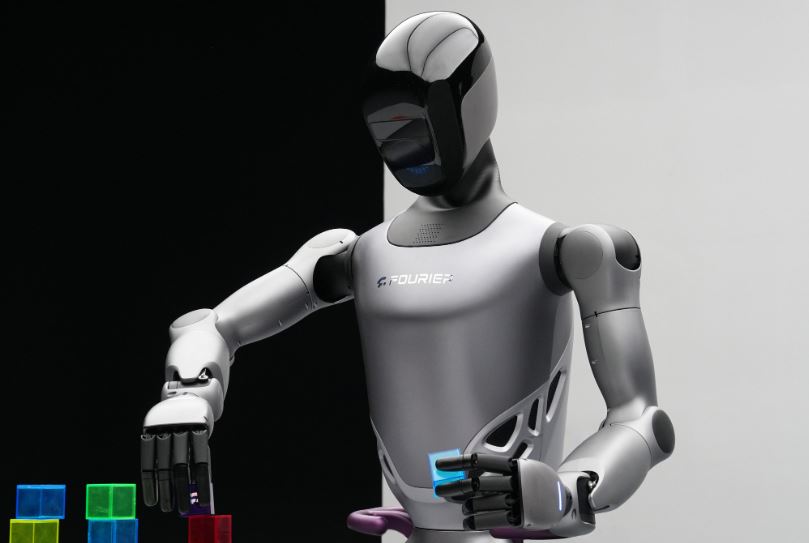
Meta is quietly giving its AI a body. According to The Information's reporting, relayed by Digital Trends, Meta built a humanoid robot prototype — internally called Max — with Shanghai-based robotics firm Fourier in roughly three months, and is already working on a second version.
Max stands about 1.5 meters tall and weighs around 48 kilograms. It runs on Nvidia's Jetson Thor chip, has five-fingered hands, built-in speakers, and a screen for a face that can mimic expressions. The prototype can reportedly pick up small objects, including bottles and toys — a long way from folding laundry, but enough of a demo that Meta showed it to select employees at its internal robotics summit in August. The build was a real joint effort: Meta's vice president of product for robotics, Li-Chen Miller, spent nearly two months at Fourier's Shanghai factory.
Work on Max 2 began in September, before the dust had settled on the first build. The next version is expected to get a redesigned torso, improved hands for better object manipulation, a projector, and additional sensors to help it navigate stairs. That's not the spec sheet of a lab curiosity — it's the spec sheet of a machine meant to move through real homes.
Here's the interesting part: Meta told The Information the Fourier work is strictly internal research and experimentation, with no plans to sell the units and no launch date set. But the strategy behind it is unmistakable. CTO Andrew Bosworth has described humanoids internally as a potential embodiment of Muse, Meta's AI agent — a way for the assistant to step off the screen and act in the physical world. The project follows Meta's May acquisition of Assured Robot Intelligence, an AI-for-robots startup, and lands just as Nvidia agreed to invest $3 billion in Meta and expand its work on Muse. Notably, it's Nvidia's Jetson Thor powering Max's brain — the chipmaker is funding the customer whose robot runs on its silicon.
The China angle will get scrutiny. As Notebookcheck noted, a partnership with a Chinese robotics firm is drawing attention at a time when US regulators have moved against connected robots from abroad over data-leak and remote-access concerns. Max was built in Shanghai; whatever Meta learns there will shape what it eventually ships — and from wherever it ships it.
The real question isn't whether a bottle-grabbing prototype becomes a product. It's what happens when every AI lab wants its assistant to have hands — and whether Meta's "research only" framing survives contact with its hardware ambitions. Watch for Max 2 details, and for how long Meta can keep calling this an experiment while building like it's a launch.
— via Digital Trends