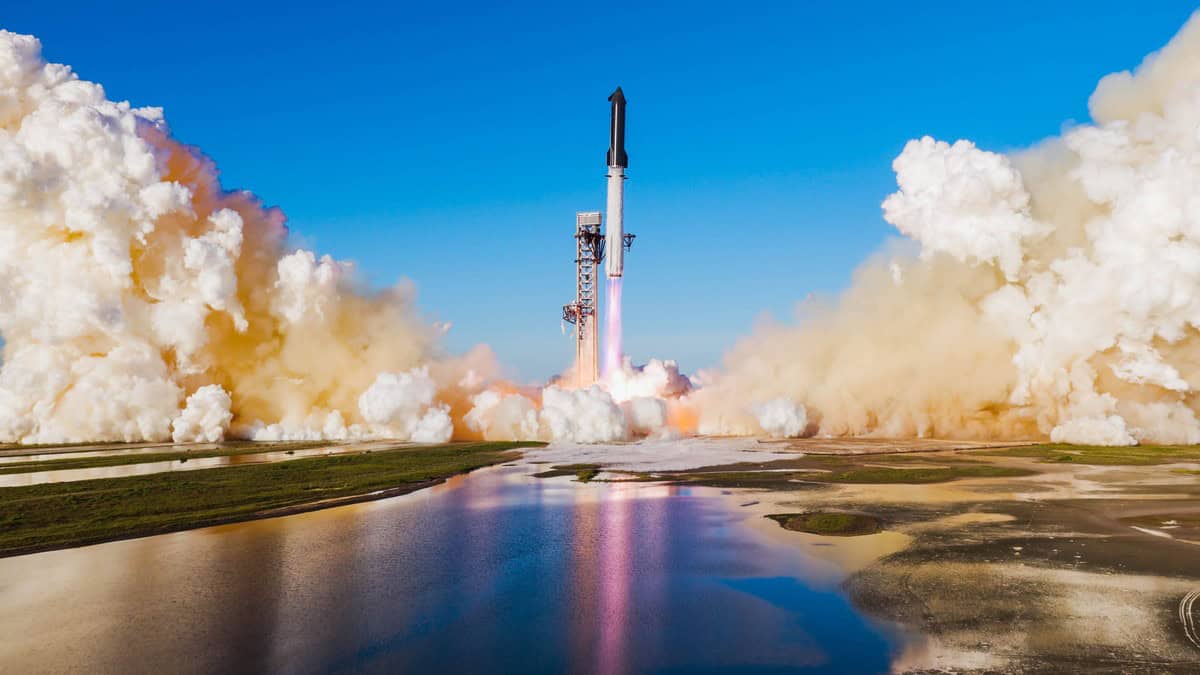
A day after Starship Flight 15 split its reusability test down the middle — the Ship caught, the booster lost — Elon Musk has explained the half that went wrong. "Booster was slightly low on fuel," he wrote on X on November 14, adding: "Slight underperformance of engines on this flight is the reason."
The detail that makes the explanation stick is the one everyone saw on the webcast: a green flame in the booster's exhaust. Musk said the green came from copper burning as fuel ran low in the engine's cooling circuit, leaving the main combustion chamber oxygen-rich — the booster, in effect, eating itself in the final seconds of its return.
That a "slight" shortfall could cost a 236-foot booster is the real story. Super Heavy lands with almost no propellant left — the margins are the point, and they are razor-thin. A small miss on ascent ripples down to the landing burn, and on Friday guidance sent the booster to the Gulf instead, where it exploded just above the water about six and a half minutes after liftoff.
SpaceX's account has shifted twice in 24 hours. The webcast first blamed a guidance, navigation and control problem; on Saturday, commentator Dan Huot walked that back — the GNC system, he said, did its job by spotting the bad position and calling off the catch. Engineer Kate Tice added that early indications were a low fuel mass alarm that cut the boostback burn short, with the root cause still under investigation. Musk's version, he cautioned, is preliminary pending a full telemetry review.
The fix Musk described is almost comically small: improve engine performance and consistency with Raptor V3.2, and shut the engines down about one second earlier during ascent, leaving more propellant for the trip home. One second, on a vehicle that burns through its tanks in minutes.
Musk said the loss does not change SpaceX's timeline for high-volume, fully reusable flights. The company aims to refly a Super Heavy and a Ship early next year, and Musk has projected roughly one Starship launch a week in the first half of 2027, according to political.org. Those are targets, not a schedule — but Flight 15 showed both halves in one day: the Ship's catch proved an orbital upper stage can come home, and the booster's loss proved the margin for error is measured in seconds of fuel.
— via Tesla North