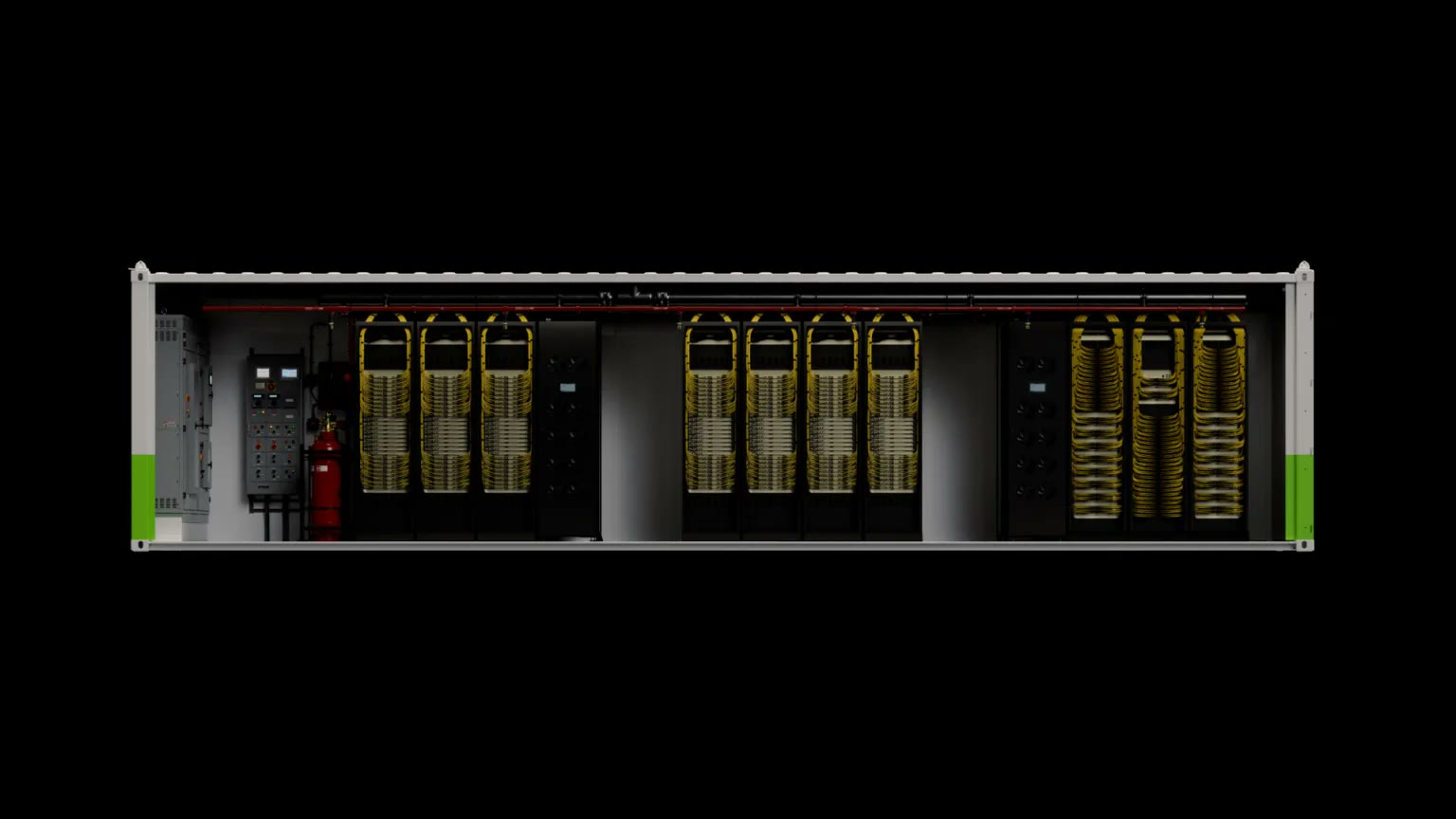
Nvidia isn't really selling chips anymore. At GTC Berlin on Wednesday, CEO Jensen Huang unveiled the DSX POD AI Factory: seven Vera Rubin NVL72 racks — roughly 504 GPUs and 252 CPUs — pre-cabled, liquid-cooled, and bolted into a shipping-container-sized enclosure weighing about 28,000 kilograms that rides to the site on an ordinary truck, according to Zotpaper's verified account of CNBC's keynote coverage.
The headline claim: what takes six months of onsite construction can start producing tokens 14 days after the container lands on a prepared site. "The only thing that has to happen when it gets to the site is it's placed in its location, connected to the rest of the other containers, and validated through final burning and testing," Ian Buck, Nvidia's vice president of hyperscale computing, said on a press call.
Here's why the container matters more than the hardware. Huang has started talking about data centers the way airlines talk about gate slots — as revenue sitting idle. On stage in Berlin, he said a one-gigawatt AI data center costs about $50 billion to build and is expected to throw off roughly $40 billion a year in revenue, meaning a three-month construction delay burns something like $10 billion in deferred revenue, per Barron's account of the keynote. "An AI factory creates value when it starts producing tokens — not when construction is complete," Huang said in Nvidia's official release.
That's the story this announcement is actually telling. Nvidia is no longer just the arms dealer of the AI boom; it's becoming the logistics company for it. The progression — single GPUs, then multi-GPU servers, then full NVL72 racks, now a container with everything pre-assembled — is really a map of where Nvidia thinks the margin is: not in the silicon, but in the dead time between "we bought it" and "it's earning."
The fine print keeps it honest. DSX POD is a reference design, not a product Nvidia ships itself. Manufacturing partners including Foxconn, Gigabyte, Lenovo, HPE, Quanta and Pegatron will build and deliver the units, with worldwide shipments starting early 2027. Nvidia disclosed no price; analysts estimate a single Vera Rubin rack at more than $7 million, so one seven-rack pod is a tens-of-millions-dollar box before you pour a single foundation.
The bet is that construction — not chips — is now the scarcest input in the AI buildout. For European customers, where permitting and skilled labor routinely stretch timelines, a truck that shows up with a working data center inside could turn out to be the most consequential product Nvidia has ever shipped.
— via Zotpaper