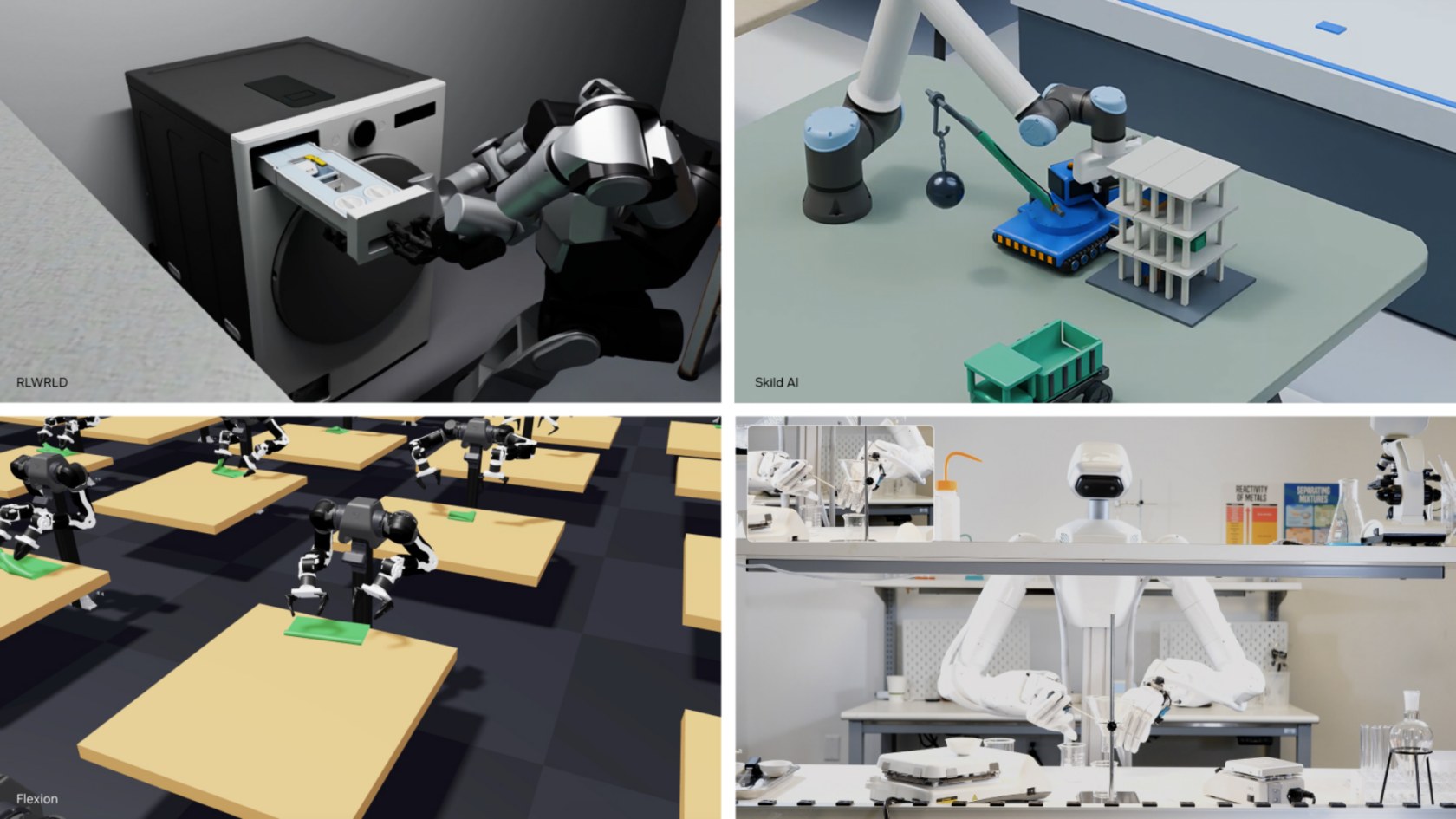
Robot hands have been dexterous enough for years. The bottleneck is teaching them anything new without engineers hand-coding every motion. Nvidia's answer, unveiled Monday at the Conference on Robot Learning in Austin, is to stop programming robots and start showing them: GR00T 2 is a robot foundation model that learns manipulation skills largely by watching first-person video of humans doing the job, according to the company's announcement.
The idea is a world action model — it predicts what a scene will look like as a task unfolds and the robot actions that get it there, in one pass. Built on Nvidia's Cosmos world models and trained on 402,730 hours of first-person human video, plus gripper and teleoperation data, it uses a technique Nvidia calls X-Adapt to transfer skills learned from human hands onto new robot bodies, with no demonstrations on them.
The headline number is striking: across 50 dexterous tasks, GR00T 2 averaged 95% success after just five demonstrations of each, following a 30-minute fine-tune on a single RTX 5090. With one demonstration it managed 71%; with none, it completed 40 of the 50 tasks at least once. Foxconn, Nexuni and Siemens are already testing it on factory, laundry and industrial work.
But the 95% deserves the fine print Nvidia's own whitepaper supplies. The 50 tasks were chosen from among tasks the model learns with five demonstrations at 80% success or better — the headline rate is high partly by construction, and the zero-shot average on the same set is 40%. Real progress, just not the "five demos and done" story the number suggests.
The word "open" needs similar care. The 100,000 hours of human video Nvidia released as Human-1M-100K is genuinely open, under a Creative Commons license that allows commercial use. The model itself is another matter: the code arrives in December, and Nvidia has announced no release date or license for the weights. A smaller on-robot variant, GR00T 2 Turbo, is in the same boat.
What is available now is the surrounding machinery: Isaac Lab 3.0, the open-source simulation framework where skills are trained before touching hardware, and two new benchmarks — DexBench for dexterity across retail, logistics, manufacturing and hospitality, and VABAR from UC Berkeley. The model is a claim; the stack is what lets anyone else test it. Watch whether the December code drop includes the weights — and whether an independent lab, not Nvidia, reproduces the 95%.
— via NVIDIA Blog