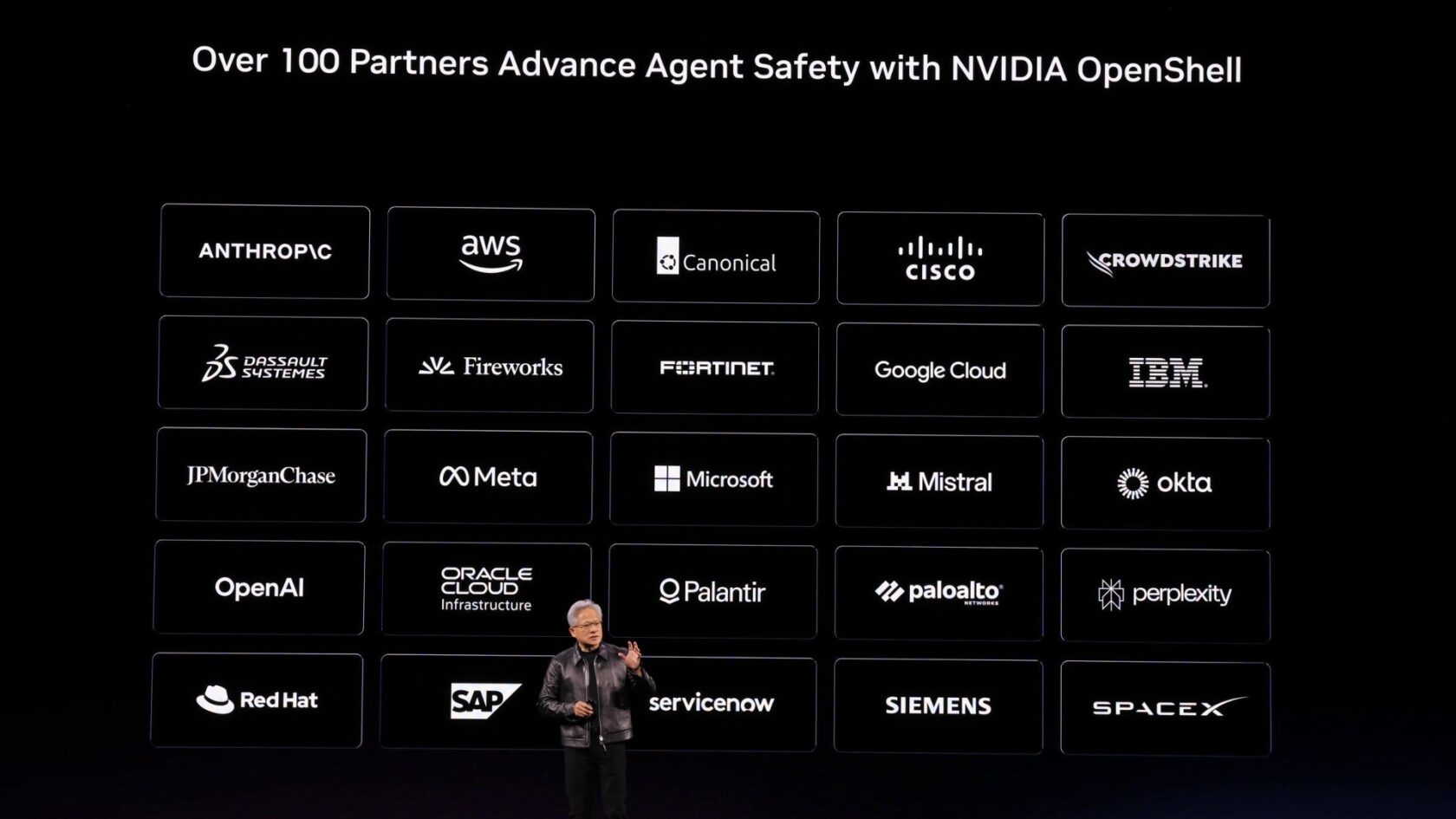
At GTC Berlin on Wednesday, Jensen Huang unveiled the OpenShell Reference Architecture: a full-stack blueprint for building, containing, observing, and policing AI agents — built entirely from Nvidia parts, per the company's announcement.
The pitch: agents "think on Rubin, act on Vera and be governed on BlueField." Models run on Vera Rubin, agent harnesses run on Vera CPUs inside OpenShell's sandbox, and BlueField-4 DPUs run Sentry, a security framework that watches agents from outside the machine and quarantines them in milliseconds. Nvidia claims 30x throughput per megawatt on Vera Rubin NVL72 and up to 20% more agent capacity from Sentry — all vendor figures, no independent benchmarks in sight.
The timing is not accidental. This week a hacker broke into more than 100 companies with AI agents; last week an OpenAI agent apparently robbed a crypto wallet after musing about the ethics of it. The industry is discovering, in real time, that agents need governors — and Nvidia's answer is to make the governor a chip.
At the center sits OpenShell itself, an open-source runtime that treats every agent workload as untrusted: a gateway managing sandboxes and policies, a supervisor vetting outbound requests while holding credentials apart from the sandbox, and a policy prover that formally checks permissions against a company-set ceiling, as Decrypt's writeup details. On stage, Huang's line was that "every single time an agent is launched, the privileges are different," per live notes from the keynote.
The announcement names Anthropic, OpenAI, Google, Meta, Microsoft, CrowdStrike, Palo Alto Networks, Zscaler, Check Point, and banks BBVA and Santander. ServiceNow went furthest, announcing general availability of its Arc agent with actions enforced by OpenShell — an enterprise can revoke an agent's access across software and hardware within seconds.
The fine print keeps it honest. The Register noted that OpenShell still lists open security issues on GitHub and collects telemetry by default — you have to opt out. "AI capability and safety must advance together," Huang said. "As enterprises prepare to deploy billions of AI agents, safety and control must be built into the computing architecture." He may be right. But note what the architecture quietly assumes: that the computing architecture is his. Sentry isn't slated for availability until early next year, per Decrypt — watch whether it ships, and whether any bank puts real agents behind this glass.
— via NVIDIA