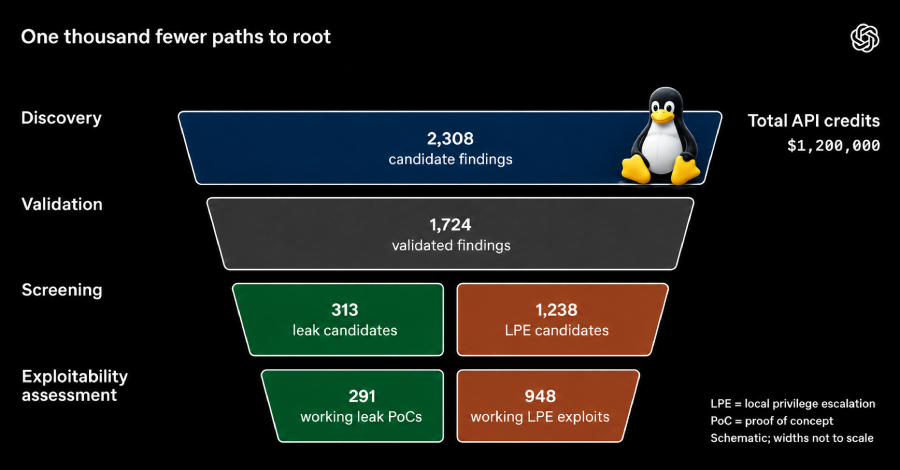
An unreleased OpenAI model spent ten days reading the Linux kernel and came back with 948 ways to become root — and a receipt for $1.2 million in API credits.
OpenAI detailed the run on Wednesday, and the numbers reframe the field. A five-stage agent pipeline — scout, analyst, triage, exploit development, patch generation — sifted 2,308 candidate findings from about 2.8 million lines of kernel code, reproduced 1,724 of them within 30 hours, and turned them into 1,169 working local privilege escalation exploits covering 948 distinct bugs, each with a candidate patch. Total bill: $1,213,430, or $1,279 per root exploit. A successful exploit averaged $359.
The speed-up over OpenAI's own previous run is the part that should make everyone sit down. The same harness in July, running GPT-5.6 Sol, found 166 unique LPEs for $513,690. Three months and one model generation later, on a kernel that had been hardened in between, the count was nearly six times higher — and cheaper per bug. Sample the exploits and it gets stranger: the agents used at least 10 exploitation techniques that outside kernel experts had not seen before, including new ways to spray objects into a target cache and data-only paths to root. OpenAI is withholding the technical details, for obvious reasons.
This wasn't rigged: the test machines ran a stock desktop distribution with the standard protections on — SMEP, SMAP, KASLR, hardened usercopy — under the same threat model used by Pwn2Own. And the defense side of the ledger is moving too: by the time the scan finished, 61 of the bugs were already patched upstream, 43 had staging patches, and OpenAI says hundreds of reports and fixes have gone to Linux maintainers under its Patch the Planet initiative.
The same pipeline that hands defenders 948 patched bugs at $1,279 each hands anyone with a big enough API budget a root-exploit factory. OpenAI's own advice is blunt: "For the near and medium term, having access to a low-privileged account on an operating system that isn't up-to-date on its latest available patches should be considered functionally equivalent to root access for a well-resourced threat actor." The UK's National Cyber Security Centre said Tuesday that AI tools have "almost certainly" driven a surge in zero-day discovery. The window between found and exploited is shrinking on both sides — and the patch rate only helps if users actually install the updates.
— via The Hacker News