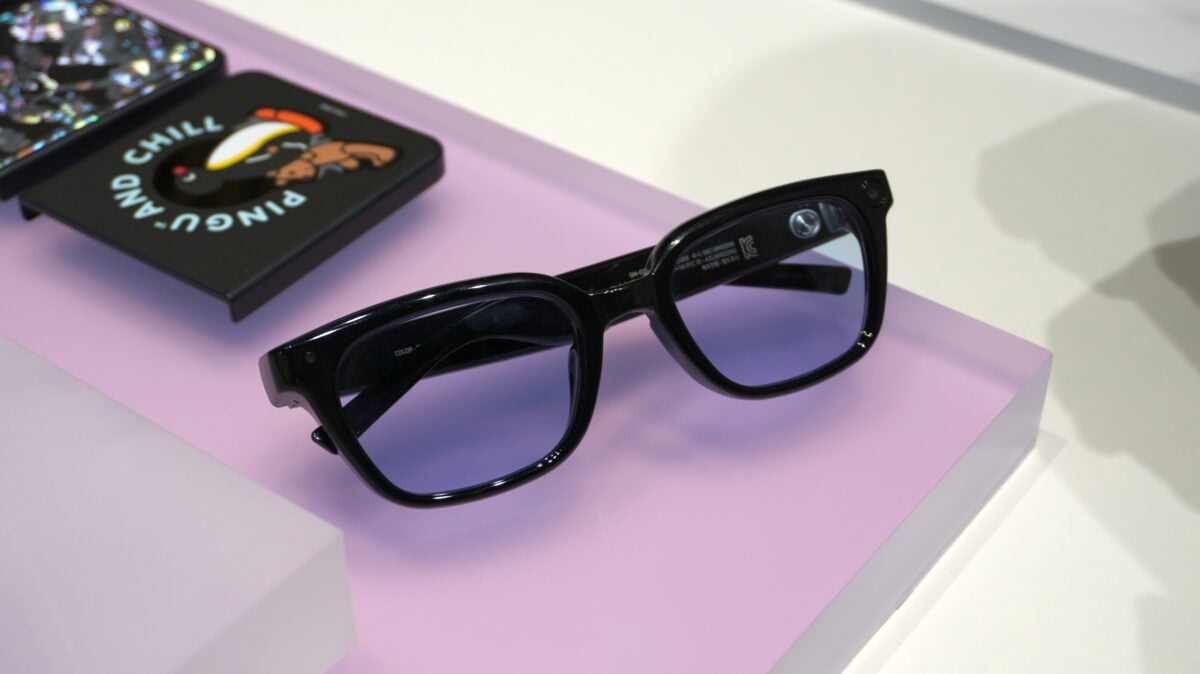
After a year of teases, Google's smart glasses are finally something you can buy. According to SamMobile, Samsung opened pre-orders on November 12 for its Intelligent Eyewear — Gemini-powered glasses built with Google — with general availability on December 10 in the United States and South Korea.
The price starts at $395, and the distribution is the tell. These aren't being sold as a gadget. Warby Parker offers 14 variants across three frame designs starting at $395, while Gentle Monster's 16 variations across six styles run $449 to $489. You buy them through Warby Parker's stores and website or Gentle Monster's online shop — the same places you'd buy ordinary glasses.
The hardware is deliberately restrained. There is no display at all, so nothing is overlaid on your view; every answer arrives as audio through open-ear speakers. A 12-megapixel camera, four microphones, and Qualcomm's Snapdragon AR1 Gen 1 chip power the experience, with up to nine hours of mixed use and 72 hours total with the charging case. At around 41 grams, they weigh about as much as a normal pair of frames.
What they do is the familiar smart-glasses pitch, executed through Gemini: identify landmarks, translate a conversation live, navigate with Google Maps, summarize a whiteboard into Samsung Notes, and read out grouped notification summaries. The catch is the phone: processing is split with your handset, so the full experience needs a Galaxy on One UI 9.0 or newer, a Pixel 7 or up, or an iPhone 13 or newer with 6GB of RAM. Bixby only works with a Galaxy.
Google is also making a privacy promise that will be tested the moment these hit the street: visuals Gemini collects are not used for AI training or ad targeting, and an LED, an inner light, and a sound mark when the camera is recording — capture stops if the LED is covered or fails. The glasses are intended for users 18 and over.
The real contest here isn't specs. Meta has owned this category with its Ray-Bans, and last month it launched a camera-free audio pair at $349. Google and Samsung are betting the way past that head start isn't a better chip — it's making the glasses look like glasses first, and letting the AI be the feature you discover after you put them on. December 10 is when we find out whether shoppers agree.
— via SamMobile