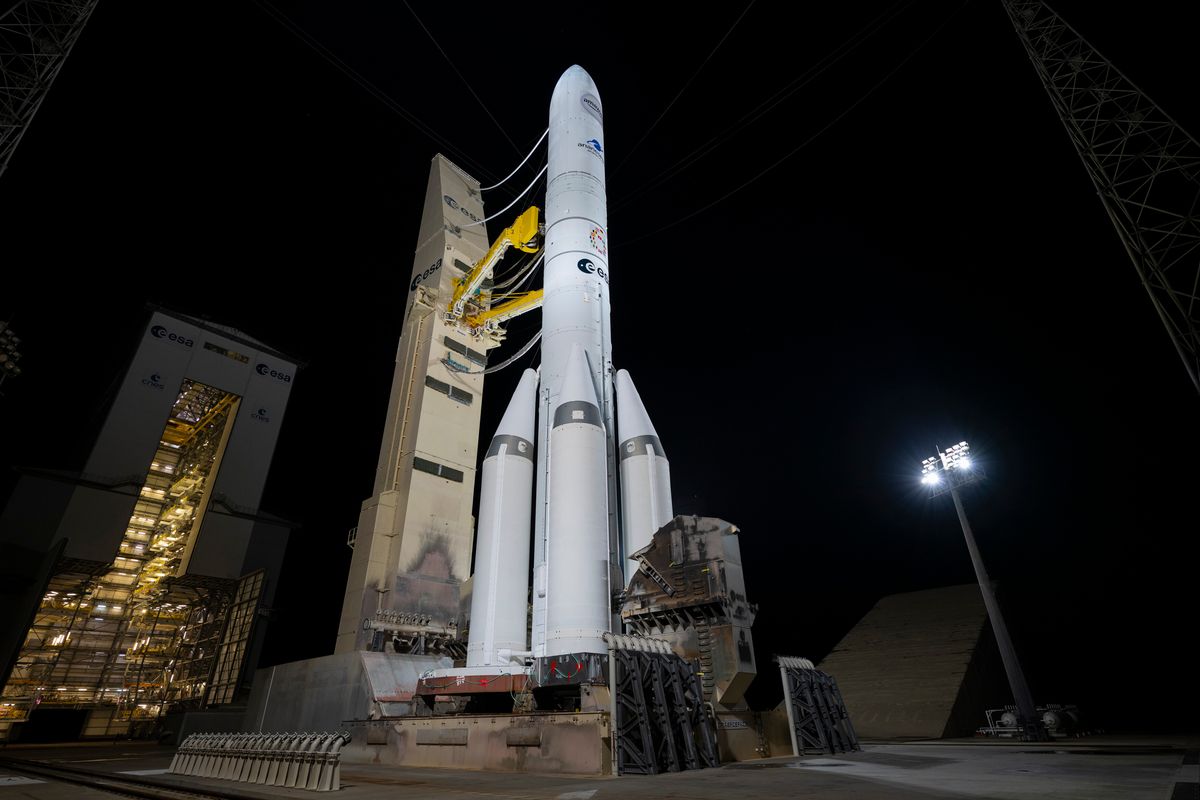
Amazon's comeback launch is finally off the ground. An Ariane 6 rocket lifted off from Europe's Spaceport in Kourou, French Guiana, at about 6:15 a.m. ET on Tuesday carrying 36 Amazon Leo satellites — the first batch to fly since a Vulcan rocket failed nine days ago and took 40 of them down with it, according to Bloomberg.
It nearly didn't happen twice. Monday's attempt was halted hours before liftoff by a technical fault in the ground equipment, and Tuesday's rocket went up at the very end of its 29-minute window — a 5:45–6:14 a.m. ET slot Arianespace set only after overnight checks on the same ground systems that scrubbed the first try. As of about 6:35 a.m. ET, the flight was proceeding normally: the fairings had come off, the upper stage had reached orbital velocity, and the 36 satellites were still attached, with separation expected at about 8:18 a.m. ET — roughly two hours after liftoff. That part is not confirmed yet.
The numbers are what make this flight matter beyond the launch itself. Amazon had 392 Leo satellites in orbit before today; these 36 take it to 428, and bring Arianespace's total Leo launches to 136. The constellation is supposed to reach 3,232 satellites, with the FCC requiring the full first generation in orbit by July 30, 2029 — and Amazon, which built its 1,000th satellite in October, says the network is already the third-largest in orbit.
But the schedule behind those numbers is fraying. Vulcan is grounded pending an FAA-accepted investigation into the November 15 failure — ULA's preliminary finding points to too little fuel reaching the BE-4 engines — and Blue Origin's fourth New Glenn rocket, booked to carry 48 Leo satellites, was destroyed along with pad infrastructure in a static-fire explosion, pushing its return to early 2027. That leaves Ariane 6 as the only rocket actually flying for Amazon right now, a European workhorse carrying the recovery of an American constellation while its two biggest launchers sit on the ground.
The watch now is the separation at about 8:18 a.m. ET. If all 36 deploy cleanly, the satellites climb from about 465 kilometers to their 630-kilometer operating altitude over the coming days — and Amazon's race against Starlink, stalled for nine days, starts moving again.
— via Bloomberg