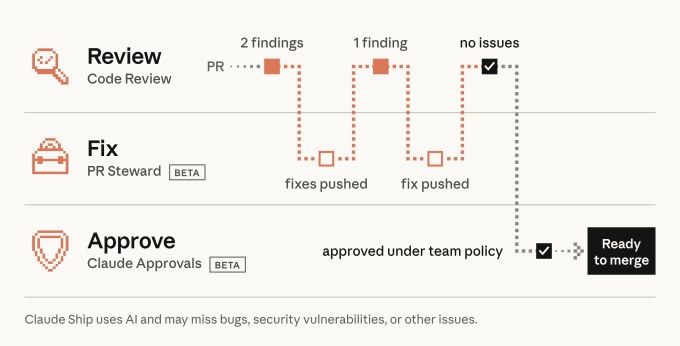
Anthropic just crossed the line its own coding tools had been circling for a year. On Monday the company launched Claude Ship, a suite of agents that doesn't just write your code or review it — it decides when the code is good enough to merge.
The setup is three agents working a pull request in sequence. Code Review, already generally available, does the deep review. PR Steward, new and in beta, chases down the unglamorous aftermath: failing CI checks, merge conflicts, review feedback — and it comments after every push explaining what it changed and how to roll it back. Then comes the part that matters: Claude Approvals, also in beta, applies an approval policy the team writes in plain language and stores as a file in the repository. If the policy says a change is routine, Claude approves it itself. Anything else goes to a human.
The framing from Anthropic is blunt. "Most teams want a person to approve every change, and that's easy to keep up with when people write every line. But a lot of developers build with agents now," the company wrote in its launch post. "On the Claude Code team, Claude writes most of our code, and we wanted everything after the PR to move that fast too."
That last sentence is the tell. Anthropic is eating its own cooking at a scale nobody else can match: it replaced Git with its own Scion system last month after Claude was pushing merges past 30,000 a day. The bottleneck was never writing code anymore — it was the human at the end of the line saying yes. Ship removes that human for the changes a team has pre-cleared, and Anthropic's own numbers say the experiment works on its own team: merged pull requests more than doubled from June to September, while the share that had to be reverted fell by more than 40%.
The guardrails are real but voluntary. Ship is in beta for Claude Team and Enterprise customers on GitHub repositories only, and Anthropic recommends running approvals in observe-only mode first, starting with a single repo and setting monthly spend limits. Teams keep control of where it runs, how deep the review goes, and what gets escalated. And as one Gartner analyst noted, this is less a breakthrough than an evolution of code review tools that already existed — the novelty is the approval, not the review.
That distinction is exactly why it matters. Review tools advise; approval tools decide. The moment a policy file — written by the team, enforced by the model — becomes the merge gatekeeper, the question stops being whether AI can write good code and becomes whether a team trusts its own written rules enough to let a machine enforce them. Anthropic is betting the answer is yes, at least for the routine stuff. The rest of the industry gets to watch what happens when the first company lets the agent hold the keys.
— via TechCrunch