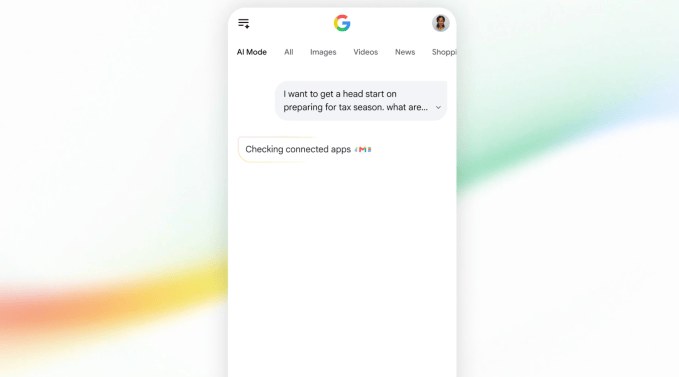
Google's search box has spent the year learning to read your inbox, your calendar, and your photos. On Monday, it asked for the rest of your life. The company announced that Personal Intelligence, the opt-in feature letting AI Mode draw on your Google apps, is expanding to Google Wallet starting today, with Drive and the Gemini app to follow in the coming weeks.
The pitch is a search engine that actually knows you. Connect Wallet and AI Mode can map your financial milestones and squeeze more out of your credit cards. Connect Drive and it pulls scattered docs behind a big decision into one answer, like a tax-season plan. Connect the Gemini app and a conversation you started with the chatbot carries straight into Search, and vice versa.
Google stresses the limits. Wallet access is read-only: "If you choose to connect your Wallet, AI Mode can only read information from your accounts; it can't move, manage, or invest your money." Every connection is opt-in and reversible, and a new Personalization icon will soon show what context AI Mode used — correctable in-thread, e.g. "I'm no longer a vegetarian."
That is the generous reading. The less generous one starts with what Google's announcement doesn't mention: advertising. Its privacy policy, revised October 16, says "Search may process some of the data that you allow Search to access to personalize content, including ads" — the same month Google confirmed testing ads in AI Mode for Personal Intelligence users. AI Mode now carries ads in 11 countries, with Brazil, Mexico, and the UK due by year's end. Google has not said whether spending records, Drive files, or Gemini conversations can inform ad targeting.
Gemini's documentation adds another wrinkle: summaries and inferences from Wallet data can answer prompts, train models, and be seen by human reviewers. That is a long way from the read-only promise in the announcement.
A month ago Google quietly changed its privacy promise to let Gmail feed ad personalization; now the same logic extends to the apps holding your money, documents, and AI conversations. The trade is real — a search engine that knows your finances and files is genuinely more useful. But the data making it useful is the same data that makes advertising valuable, and Google is asking users to hand it over before answering the one question that matters: what it does with it next.
— via TechCrunch