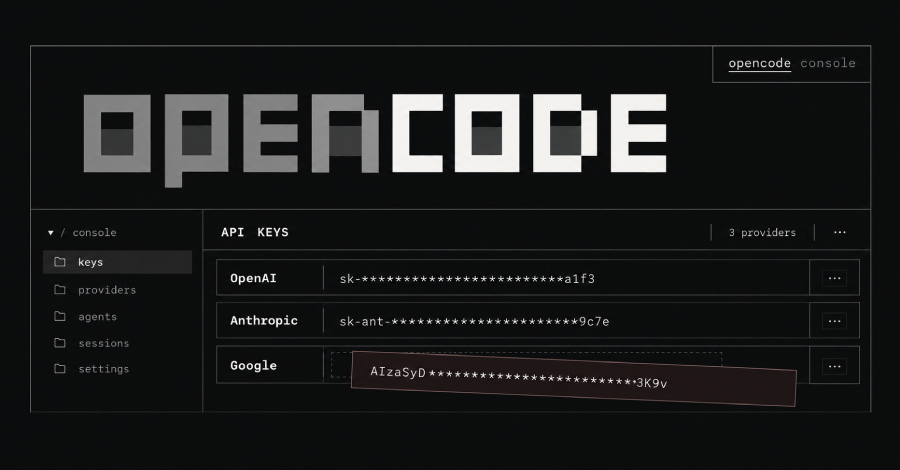
The most valuable thing in a developer's AI setup right now isn't the model — it's the key. OpenCode learned that this weekend. On the night of October 16, an intruder reached a legacy system at the company and may have exposed the third-party API keys users had saved in OpenCode Console, according to The Hacker News.
Console is OpenCode's optional hosted service: a workspace stores its own OpenAI, Anthropic, or Google key there, and Console calls the provider on the team's behalf so nobody has to pass keys around. The affected group is 1.4% of Console users — everyone who had an outside provider linked — and OpenCode emailed them on October 17 with the subject line "Action Required: Potential provider key breach," telling them to revoke those keys at the provider and replace them.
Here's the part that makes this nastier than a password leak: a provider API key is a bearer credential. Whoever holds a copy can run billable requests against your account until you revoke it at the source — deleting the key from Console does nothing, and a Console budget can't cap rogue use because that traffic never passes through Console's gateway. Some users say the damage is already real: Dealroom reported that Colin Parsons had $281 of unauthorized OpenAI usage and $168 on Anthropic, while Preston Zeller put his losses at $1,700. A Reddit user claimed $400 on Anthropic; another cited roughly €200 of Google usage. OpenCode's own wording is more careful — the keys "may have been exposed," and the company hasn't confirmed any key was copied or used.
What raises eyebrows is OpenCode's explanation. Its October 17 post described the breach as "related to a large-scale distillation attack" — but didn't name anyone or say how the two connect. Distillation is the model labs' term for campaigns that vacuum up a model's answers to train a rival, and Anthropic said back in September that the labs behind such campaigns reach its models through fake accounts built with stolen credit cards, login credentials, and harvested API keys. If that's the motive here, OpenCode's keys weren't the end goal — they were the raw material.
The incident is still live. Co-founder Dax Raad wrote on X on October 18 that attackers had been "non stop trying to attack our systems for the past 48 hours," adding that "a side effect is everything is getting hardened." He also drew a careful line: the breach involves "the OpenCode Console, not OpenCode itself" — keys pasted into the hosted Console were at risk, while keys used by the CLI and desktop apps stay in a local SQLite database and "never come to us."
That distinction is doing a lot of work, and it's the part worth watching. The industry has spent 2026 racing to make AI agents that hold more of your credentials — bank accounts, inboxes, now model keys — while the companies building them split hairs about which subsystem counts as "us." OpenCode also hasn't said what the legacy system was, how it was reached, how many keys it held, or how many users 1.4% actually represents.
If you ever pasted a provider key into Console: revoke it in the provider's dashboard, make a new one, update every app and script, and review usage back to October 16. Then set a spend limit and give each tool its own key — the whole point of that discipline is that a copied key does less damage and leaves a shorter paper trail. The era of the model key as the crown jewel just started, and OpenCode is the first of these agent-tool companies to lose one.
— via The Hacker News