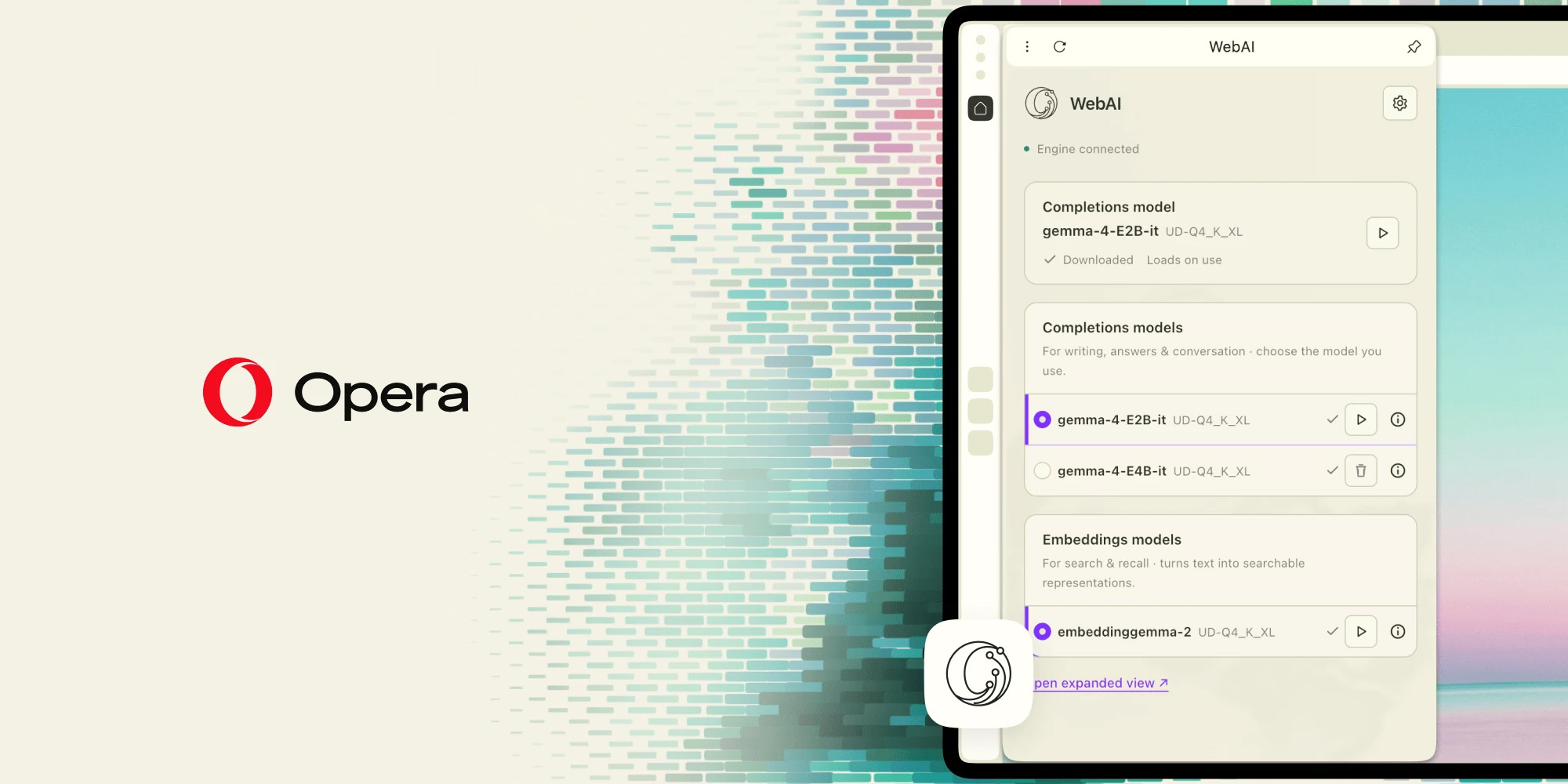
Opera wants your laptop to do the AI work that right now happens in someone else's data center. On Tuesday the company flipped on WebAI, a proposed web standard that lets websites and browser extensions call AI models running locally on your own machine — no cloud API, no account, no per-request bill.
The feature is live as an opt-in early preview across Opera One, Opera GX and Opera Neon, according to Opera's announcement. To turn it on, users go to Settings → Opera AI and enable "Enable Web AI API" — nothing is downloaded until they do, and it can be switched off again at any time. At launch the browser can run Google's open-weight Gemma models (Opera's own artwork shows Gemma 4 variants), plus Apple's on-device foundation model on compatible Macs, 9to5Mac reports. The preview covers 64-bit Windows PCs on Intel or AMD chips and Apple Silicon Macs — no Intel Macs, Linux, or Windows on Arm.
"A lot of what people want from AI doesn't need a data center. Your laptop can already do it, without sending your data anywhere," said Krystian Kolondra, Opera's EVP of browsers and AI. "We first shipped local models to developers in 2024. Now we're bringing them to everyone."
Developers get three building blocks — Prompt, Decision, and Semantic Embeddings APIs — for generating text, classifying content, and measuring how pieces of content relate. Because inference happens on the user's machine, sites skip per-request cloud costs and API keys; per-site permissions decide which pages may use the local model at all. Opera shipped six experimental extensions to show the range, from a tab organizer to a clickbait flagger.
The honest caveat, as Computerworld's reporting notes: local inference keeps your text away from cloud AI providers, but it doesn't control what a website does afterward — a site can still forward the model's answer to its own servers. Analysts warn that malicious sites could target the local model through hidden prompts, and the Prompt API underpinning WebAI is still a W3C Community Group proposal with no commitment from Firefox or Safari.
The bet is simple: the model gets downloaded once and shared by every site you allow, instead of every site shipping its own copy. If that interface catches on, the browser becomes the AI platform — and the cloud bill stops being part of the deal.
— via Opera