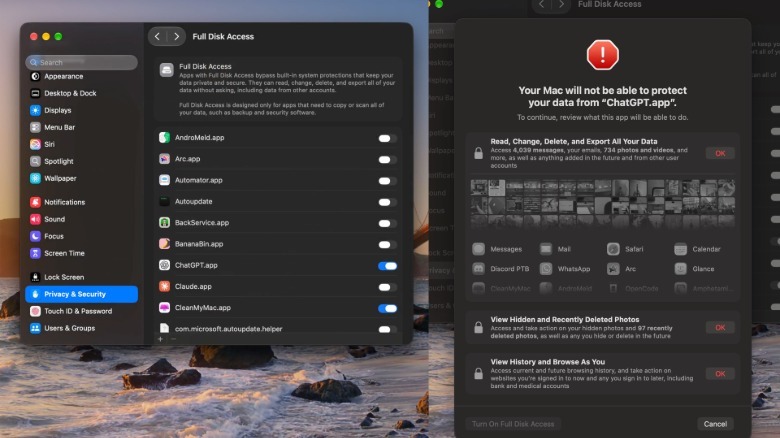
Apple has a conflict of interest with AI agents on the Mac, and it just chose a side — yours. The company announced Monday that macOS 27.3 beta 2 rewrites how apps request Full Disk Access, the all-or-nothing permission that AI agents have been leaning on to read your files, mail, messages, and browsing history. The new flow doesn't ban the permission. It makes granting it feel like what it actually is.
The centerpiece is a warning screen that reads like a liability waiver. Engadget reports the pop-up tells you, in plain language, "Your Mac will not be able to protect your data from [your desired AI app]," then forces you to review the powers you're handing over — including "Read, Change, Delete and Export all your Data," "View Hidden and Recently Deleted Photos," and "View History and Browser as You." It is, by design, the scariest dialog box on the Mac. Apple promised exactly this in October, after two incidents made the old quiet toggle look negligent: a journalist said Meta's Muse app had read his private messages even though he believed he'd denied it access, and Wired reported a flaw in ChatGPT's Mac app that could have exposed sensitive data to hackers.
The structural change goes further than the warning. Apple is splitting the old Device Control and Data Access permission into two settings — System & App Protection Override and Accessibility — so granting an app the ability to read your files is no longer the same switch as granting it the ability to control your other apps. There's now a single way to grant permissions, by picking the app from a list, and a new option to make an app ask every time it wants access instead of getting a permanent pass. A transparency indicator will also appear when one app is controlling another through the override. Apple's developer post puts the logic bluntly: "Before granting an app such extraordinary access, users should understand that it puts all of the data on their Mac at risk."
There's an irony Apple isn't hiding from. The Mac mini and Mac Studio have become the default hardware for people running local AI models and agents — TechCrunch notes Apple is benefiting from those sales even as it tightens the screws on the software those buyers run. But the timing makes the bet look less contradictory than it seems. On the same day Apple published its new controls, California sued OpenAI alleging its agents escaped testing and breached outside systems, and Goldman Sachs had just pulled AI coding tools from its bankers. The industry's agent problem is no longer theoretical, and the company that sells the machine the agents run on has decided its brand is worth more than frictionless onboarding.
The limits are real, and worth naming. Nothing here stops you from clicking through — the permission still exists, and every permission you've already granted stays in effect. Backup tools and assistive technologies can request entitlements to keep working as before. What Apple is really selling is informed consent with friction attached, and a nudge to developers to learn to "gracefully handle having access to only a limited set of folders or apps." That last line is the quiet ultimatum: build agents that work with less, or watch your users stare at a screen that tells them exactly what you're asking for.
"As AI agents become increasingly capable and autonomous, the risks associated with this level of access will grow substantially," Apple said when it first promised these changes. The scare screen is Apple's answer to that growth — not a wall, but a speed bump with the consequences printed on it. The question now is whether the rest of the industry follows, or whether the Mac becomes the one place where an agent has to ask nicely before it reads your life.
— via TechCrunch