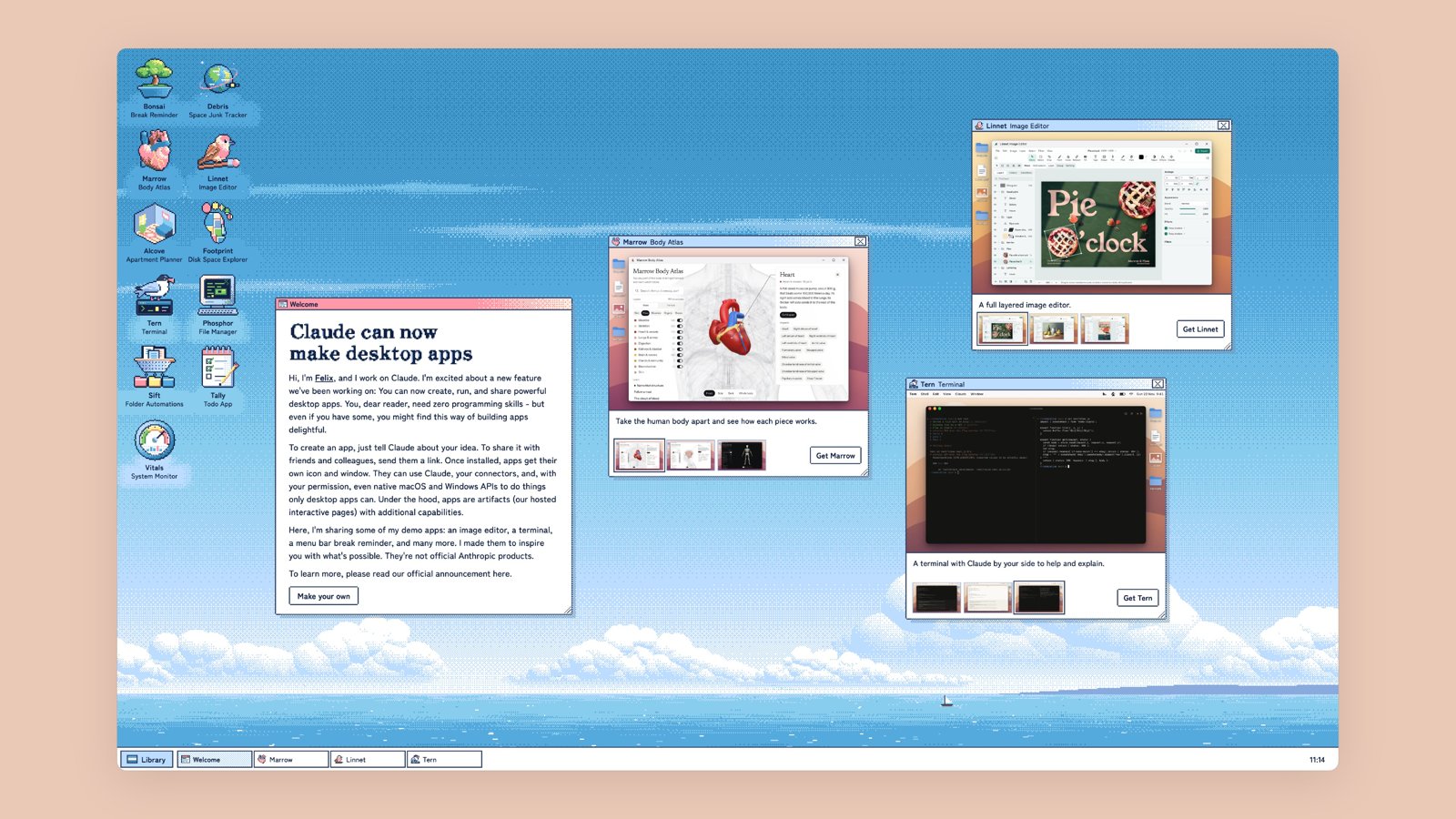
Anthropic announced Tuesday that Claude artifacts can now become real desktop apps. The new "Install as app" feature, rolling out in beta in Claude for Mac and Windows, takes the small tools people build in a chat — a meeting-prep page that pulls from your calendar, an order tracker, a cost calculator — and gives them their own icon and window, outside the Claude interface. Describe what you want, try it as an artifact, and pick "Install as app" from the Share menu. No packaging, no code signing, no API key or separate login; the app runs on your Claude account, and its requests to Claude count toward your plan's usage limits.
The move matters because artifacts were stuck inside the chat window. A tool you rely on every day should behave like the rest of your apps, and Anthropic's pitch is exactly that: installed apps can send notifications, sit in the menu bar or system tray, register global keyboard shortcuts, and keep using Claude and your connectors — calendar, email, and the rest. The company's own staff have already built a layered image editor called Linnet, a file manager called Phosphor, a folder-organizing tool called Sift, a terminal with Claude built in called Tern, and a menu-bar performance monitor called Vitals. The apps update automatically whenever the underlying artifact is edited, and you can share them with other people.
But the permission system is the real story here, and Anthropic is unusually blunt about it. There are three levels. By default, an installed app can only do what it could do in a browser. A second tier, App permissions, unlocks desktop features like notifications and always-on-top windows. The third, "Full computer access," lets an app run programs and read, change, or delete your files without asking each time. Anthropic does not review apps before you install them, and full access is restricted to apps you built yourself — or, on Team and Enterprise plans, apps built by someone in your organization. Every permission covers only the current version of the app, so Claude asks again after every update, even your own edits.
That design is honest about the risk in a way most app platforms are not: an AI-generated app is code you did not write, and granting it file access is a trust decision. The re-ask-on-every-update rule is the right answer to the obvious attack — a shared app quietly updated to do something new. The carve-out worth watching is the one Anthropic flags itself: parts of an app loaded from another website can change without Claude asking you again. And you have to be online and signed in to Claude to open an installed app at all.
This is the second Claude builder move in a week — Monday brought Claude Ship, which lets an AI approve routine code merges — and it lands alongside Google's push to let Gemini operate apps on the Mac. The race is no longer over who has the best chatbot. It is over who owns the desktop the chatbot lives on. Anthropic's answer is to let anyone ship a desktop app by describing it in a sentence, then make the permission prompt do the security work. Whether users actually trust that prompt with full computer access is the question that decides whether this is a new kind of software distribution — or a new kind of attack surface.
— via Anthropic