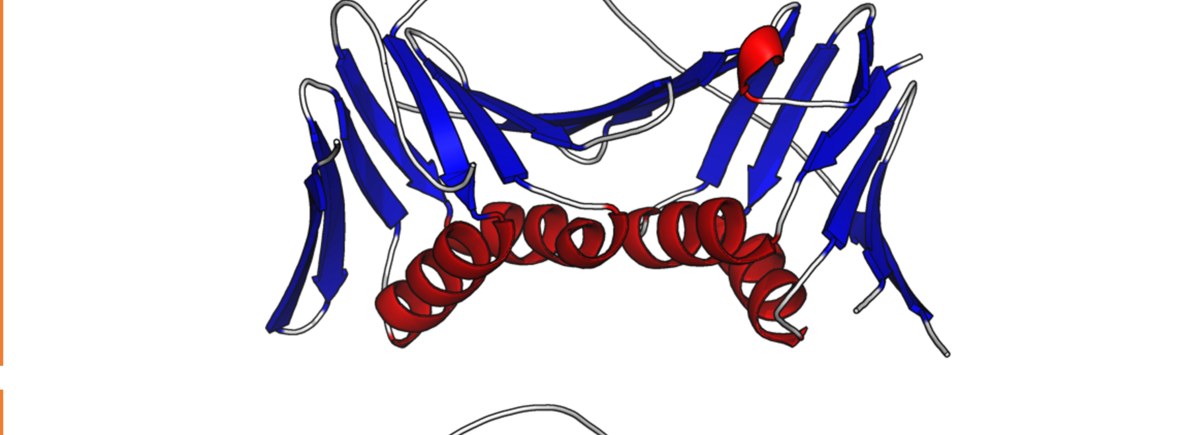
OpenAI's GPT-6 can now design proteins that actually bind to their targets in a lab — not just on a computer. The company reported Monday that a pre-release version of GPT-6.2 designed the three-dimensional shapes of small proteins called minibinders, and that 35 of 322 of them bound their intended targets when tested in the lab by research partner Onava. That is a 10.9% hit rate, with at least one hit on each of five targets, including PD-L1, a protein some cancers use to evade the immune system.
The number that matters is not the 10.9% — it is what the model did to get there. GPT-6.2 was given the 3D structures of the target proteins and told where each minibinder should attach, then wrote code to design the shapes itself, without calling a specialized biology model to generate them. Researchers could also steer it in plain language, specifying how many coils or strands a design should contain, and the model followed those instructions with near-perfect fidelity. On the sequence side, the results were stronger: when GPT-6.2 was asked to write new amino-acid sequences for existing minibinder shapes, 75 of 88 designs for MDM2 (85%) and 26 of 42 for VEGF-A (62%) still bound, and redesigned antibody loops kept binding 70% of the time.
This is the generalist-versus-specialist story that has defined the last year of AI, now playing out in a wet lab. Protein design has belonged to dedicated tools — RFdiffusion for shapes, ProteinMPNN for sequences, ESMFold for predicting how a chain folds. OpenAI's claim is that one general-purpose model can now do the design work of several of them, guided by a prompt instead of a software pipeline. Its own numbers back part of that up: GPT-6.2 matched a small molecule's observed binding position 93% of the time on the PoseBusters docking test, against 50% for the specialist DiffDock-L, and its motif-scaffolding designs beat RFdiffusion 43.7% to 27.8%.
But OpenAI is unusually candid about where the claim stops. The campaign was hybrid in practice: a specialist model, SolubleMPNN, supplied the amino-acid sequences for the first experiment, and Boltz-2, OpenDDE and ESMFold2 filtered candidates before anything reached a bench. The post states plainly that the results "do not yet establish" end-to-end design of new minibinders without that help. Predicting a complete protein structure from its sequence remains a clear weakness — GPT-6.2 scored 0.38 on the TM-score measure against 0.93 for ESMFold2 — and the original RFdiffusion study reported higher hit rates than 10.9%, though OpenAI notes rates depend heavily on how strictly designs are filtered before testing. Binding is also only the first step: the post publishes no affinity, potency or toxicity data, and says further work must establish specificity, stability and biological activity. OpenAI life-sciences research lead Joy Jiao described the work as a proof of principle, according to Nature, and noted specialist tools were still needed for key steps. The findings come from a preprint, not a peer-reviewed paper.
The biosafety angle is part of the announcement, not an afterthought. OpenAI says the work is governed by its Preparedness Framework, with a Rosalind risk-card addendum and SynthID Bio watermarking for designed sequences — an acknowledgment that the same capability that could speed up drug design could also be misused. That framing matters because the pitch here is "programmable molecular design": scientists describing what they want a molecule to do in plain language and getting candidates back. OpenAI's stated next steps are harder targets, testing whether designed molecules produce an actual biological effect — killing a cancer cell, for instance — and extending the work beyond minibinders to RNA and small molecules.
Watch the follow-through, not the headline number. If the next preprint shows GPT-6 designing binders for targets where this round fell short, and doing it with less specialist help, the generalist is genuinely eating the specialist's lunch. Until then, this is a real lab result with a clearly marked boundary — and the boundary is the story.
— via OpenAI