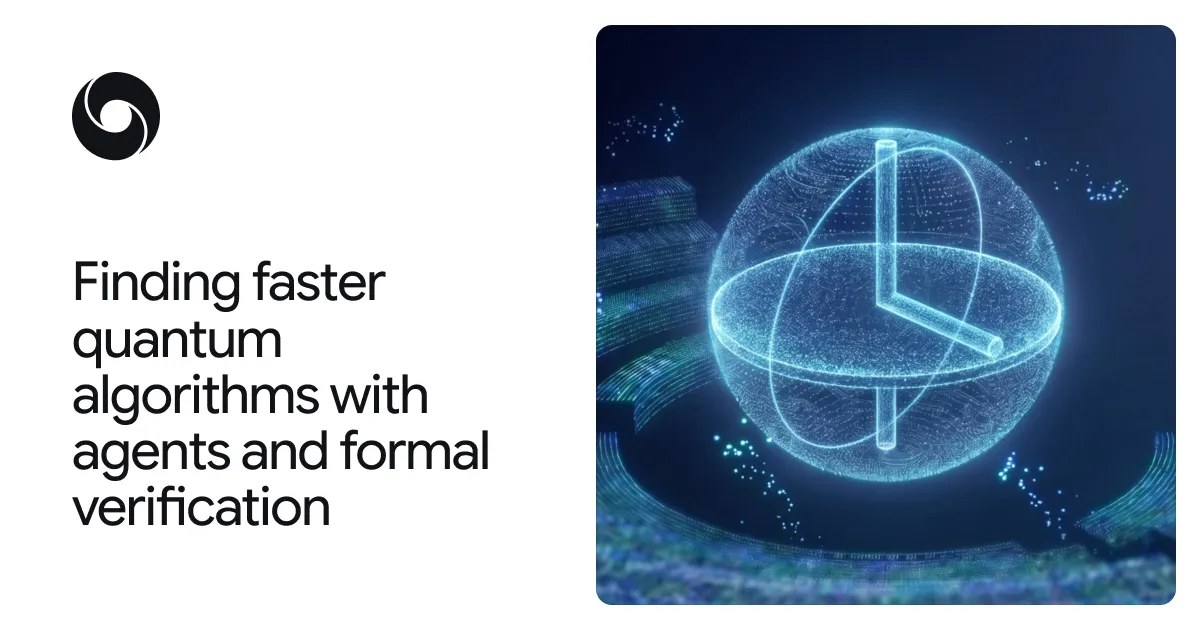
Google DeepMind just gave AI agents one of the hardest jobs in computing — redesigning quantum algorithms — and the agents came back with circuits up to 290 times cheaper. The twist is how the results were checked: not by running them, which is impossible at this scale, but by proving them correct in Lean.
The work, announced Monday by Google DeepMind and Google Quantum AI, set separate teams of Gemini 4 agents on five problems in fusion, chemistry, and drug design. Each team's ideas had to be verified in Lean before entering a shared notebook, and the teams met every four hours in a virtual conference to trade, debate, and compare notes. The headline numbers are striking: a circuit for calculating a property of inertial confinement fusion got 11.8× cheaper, with its memory requirement falling from 5,650 to 4,338 error-corrected qubits. A light-sensitive molecule's simulation got 8× cheaper. Cytochrome P450 — the enzyme that breaks down most human medicines — improved 2.5×, with memory down from 481 to 333 qubits. A specific implementation of Grover's algorithm sped up 2.57×, and arcsin, a routine other quantum algorithms use to load numbers into quantum states, got 290× cheaper.
That last number needs the usual care. It is one arithmetic subroutine, not a 290× speedup for quantum computing in general, and the baselines are DeepMind's own. DeepMind is also candid about the limit: even with these improvements, running the simulations would still demand more resources than the first error-corrected quantum computers are likely to provide. The gain narrows the hardware gap; it does not close it.
What makes this more than a benchmark press release is the method. Classical computers cannot simulate circuits of this size, and today's small quantum processors cannot run them, so testing was never an option — proof was the only check available. DeepMind built a new open-source Lean library for quantum algorithms and is releasing it, along with the problem specifications and the verified solutions, on GitHub, so outside researchers can inspect the proofs themselves.
It is also the second time this week that Lean has been the referee for an AI-discovered result — the same prover is at the center of the Riemann Hypothesis claim working its way through independent verification. The pattern is becoming hard to miss: as AI agents start producing mathematics and algorithms humans cannot check by hand, the proof checker becomes the product. DeepMind's pitch is that this loop — agents propose, Lean disposes, researchers choose the problems — compresses years of manual circuit design into an afternoon's run. The open-sourced library is the test of whether anyone else can run it.
— via Google DeepMind