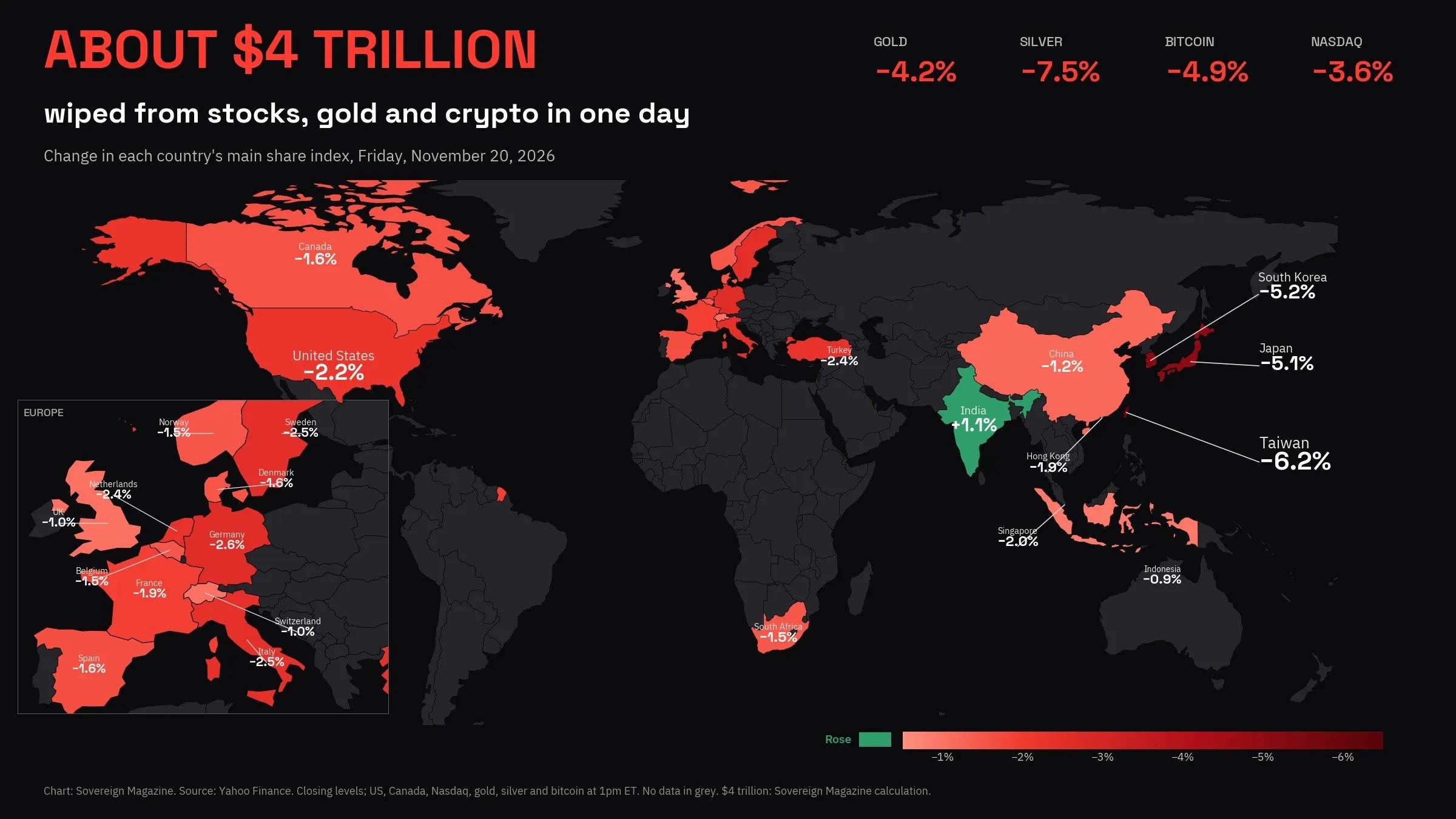
Anthropic's record IPO was supposed to restore confidence in the AI trade. Instead, it became the trigger for the worst day of the rout so far. About $4 trillion was wiped from the value of shares, gold and cryptocurrencies on Friday, according to Sovereign Magazine, as a sell-off that started in Asia's chip stocks rolled through Europe to Wall Street — and investors sold almost everything except government bonds.
The damage started in Asia, where markets were first to react to Thursday's 2% fall on Wall Street. Taiwan's Taiex fell 6.2%, leaving it 17.5% lower over the week — its worst week since 1991. South Korea's Kospi dropped 5.2%, with Samsung down 7% and SK Hynix 5.9%. Japan's Nikkei fell 5.1% to its lowest close since April, and SoftBank — the market's most leveraged bet on AI, with $64.6 billion invested in OpenAI — plunged 14.5%, its worst day since August 2024. Asian shares lost about $1.1 trillion of value in a day.
Europe was next. The Stoxx 600 closed 2% lower, and the chip companies fell furthest: ASML lost 9.3%, STMicroelectronics 10.8%, and Arm was down 11% by early afternoon in New York. By then the Nasdaq was down another 3.6% on the day and 8% on the week, with Nvidia falling 7.3% to about $135 — down every session since Jensen Huang resigned on November 11. AMD lost 11%, Broadcom 12%, and Anthropic itself touched $83.05, five cents above its $83 IPO price, before recovering to close at $88.91.
What makes Friday different from the earlier legs of the sell-off is what else fell. Gold, the asset investors usually buy when shares drop, fell 4% to about $3,530 an ounce — down 9% on the week and more than a third below its January record. Bitcoin slid below $59,000. The selling, analysts say, is partly forced: investors who borrowed to buy shares are being asked to put up more cash as prices fall, and some are selling gold and other assets to raise it. "In periods of acute market stress, investors often sell what they can rather than what they want to," Chris Weston of Pepperstone told Sovereign Magazine.
The other pressure is rates. After October inflation came in above forecasts, traders put the chance of a Federal Reserve rate rise in December at about 97%, and higher rates raise the cost of the debt that pays for AI data centers — the same debt the Fed's own minutes this week flagged as "complex and opaque." The AI trade's problem is no longer just whether the models are worth the money. It's whether the financing behind them holds up when money gets more expensive.
— via Sovereign Magazine