The patch window is dead. That is the blunt premise behind Shirudo, a new open-source project from OpenAI and Cisco that lets AI agents defend a running Linux system before a permanent fix even exists.
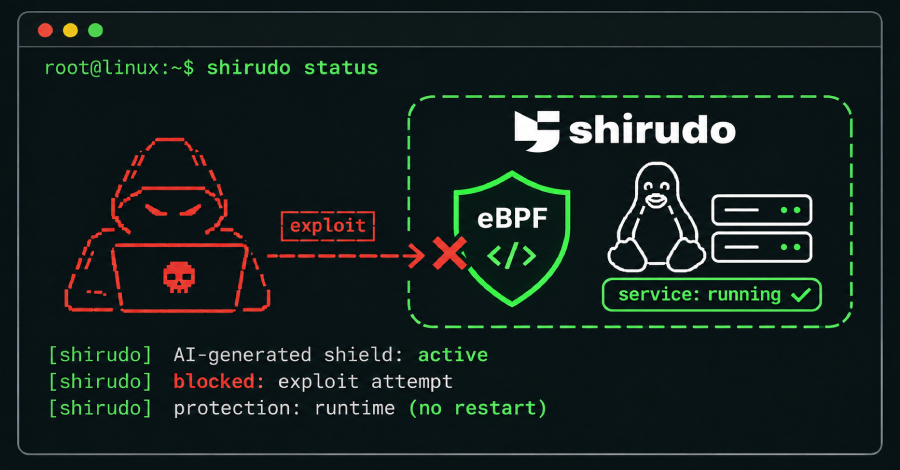
Shirudo — Japanese for "shield" — is a runtime that lets an agent write a small, targeted eBPF control, a "shield," that blocks the vulnerable code path while the service keeps running. No reboot, no downtime, no waiting for the vendor's patch to wind its way through testing and deployment. The shield is temporary by design: it retires the moment the real patch lands.
The workflow is the interesting part, because it is the mirror image of the exploit-finding AI OpenAI has spent the fall shipping. A guardian agent scans open-source code and vendor disclosures, traces a vulnerability to the affected assets and attack paths, then writes a shield and proves two things before it goes live: that it stops the exploit, and that the service still works. "The shield only graduates to active blocking when the evidence says it's safe," Cisco said. The shields are cryptographically signed, delivered as .bee packages through an OCI-compliant registry, and verified with TPMs before they load.
In a controlled test, a Codex-generated shield blocked a Java4Shell exploit against a running Elasticsearch service without a restart — the same Java4Shell flaw CISA was urging everyone to patch last week.
The urgency is not theoretical. "We need this kind of machine-speed defense because AI models have become incredibly good at finding and exploiting software vulnerabilities, and they get better with every generation," said Cisco Security CTO Thomas Graf and Isovalent's Liz Rice. Their kicker: the mean time to exploitation has become negative. Attacks now land before patches exist, which means the old model — disclose, patch, deploy, hope — is structurally too slow.
That is why this launch matters more than the usual open-source announcement. The same labs that built AI that finds bugs at machine speed are now building the other half of the loop: AI that defends at machine speed. Shirudo is built on Tetragon, the eBPF platform Isovalent open-sourced in 2022, reworked so agents — not just humans — can write the mitigations. OpenAI calls it a "first step" toward self-defending infrastructure, and the code is BSD-licensed on GitHub, though it is pre-release and needs a patched kernel and TPM 2.0 hardware.
What to watch: whether anyone actually trusts an AI-written kernel control in production. Shirudo's answer is process — signed shields, evidence-gated activation, automatic retirement — but the trust question is the whole bet. If defenders accept it, the patch gap stops being a window attackers own. If they don't, Shirudo is a clever demo of a defense nobody deploys.
— via The Hacker News