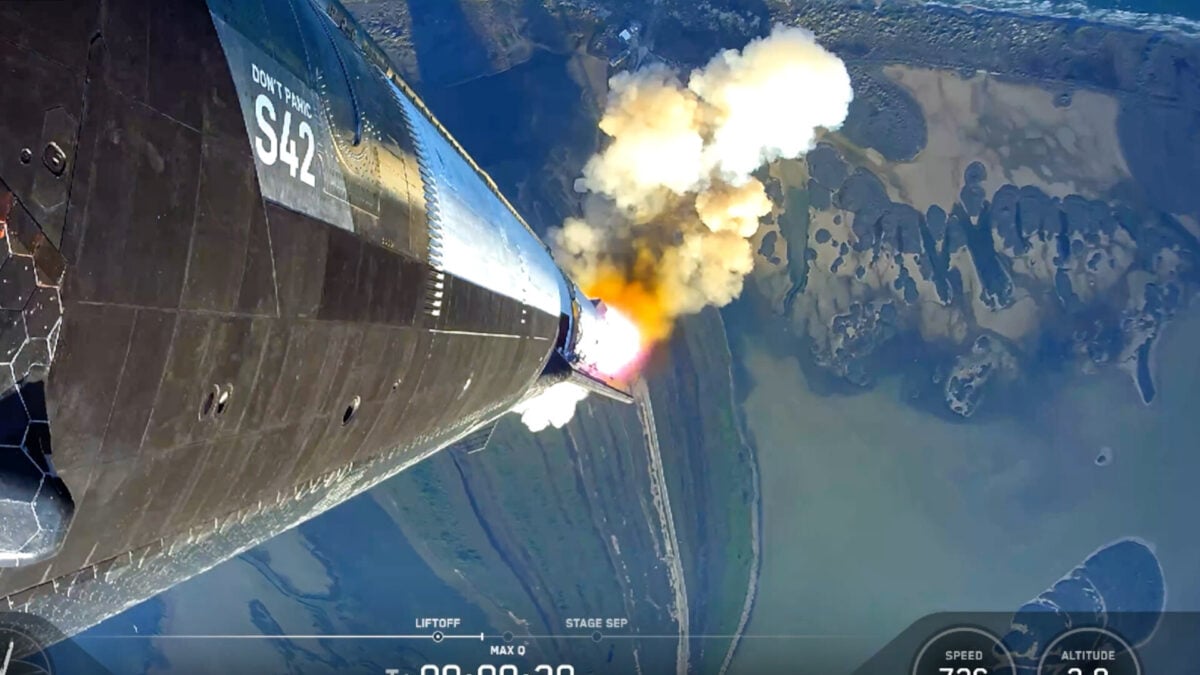
The double catch lasted about seven minutes. Starship Flight 15 lifted off from Starbase, Texas, at 5:47 p.m. ET on Friday, and by the time the Super Heavy booster was supposed to be gliding back into the launch tower's mechanical arms, SpaceX had already called it off. An unknown issue during the booster's return forced a divert, and Booster 22 splashed down in the Gulf around 5:54 p.m., according to Gizmodo. SpaceX said it does not yet know what caused the abort.
That is the first half of the mission gone — and it stings, because the booster catch was supposed to be the routine part. SpaceX has pulled it off three times before, most recently in March 2025. The hard part was always the second act.
But the second act is still alive. Ship 42 — "Don't Panic," stenciled on its side — climbed to orbit on all six engines, the second time a Starship has reached orbit, and flight controllers polled "go for orbit" just after 6 p.m. ET. The first of its 26 Starlink V3 satellites deployed at 6:25 p.m., according to Florida Today, and the ship is now settling into a roughly 22-hour, 14-orbit coast.
If it stays healthy overnight, SpaceX will attempt the first-ever catch of an upper stage on Saturday afternoon, in a window the FAA lists from 2:56 to 6:14 p.m. Central, per The Vermilion Times. That is the catch that actually matters: the booster is a solved problem having a bad day. Nobody has ever caught a vehicle falling out of orbit before, and the ship comes home far faster than the booster ever did, descending from orbital altitude in a belly flop before flipping vertical into the tower's arms.
So Friday's flight is now a one-act test of the hardest thing SpaceX has ever attempted — and a reminder of how thin the margin is. A fully reusable orbital rocket is still the prize, and after tonight, exactly half of it is still in play. The verdict lands Saturday afternoon.
— via Gizmodo