Correction: This article was published shortly after liftoff, before the mission's outcome was known. Vulcan failed about ten minutes into flight, when the Centaur upper stage malfunctioned during its first burn — all 40 Amazon Leo satellites were lost, and Vulcan is grounded pending investigation. Read our report on the failure.
Third time was the charm — barely. United Launch Alliance's Vulcan rocket finally lifted off from Cape Canaveral at 12:40 p.m. ET on Sunday — the last minute of its 29-minute window — carrying 40 Amazon Leo satellites into orbit. Florida Today reports all six boosters separated 1:45 into flight, 22 miles up.
The countdown wasn't smooth. With three minutes to go, controllers held the clock on a computer-checked redline limit violation, rewound to T-7:00, and spent 26 minutes clearing it. It was the third attempt in three days: Friday's died on a power interruption at a supplier's nitrogen plant, Saturday's on a network fault between the ground equipment and the vehicle.
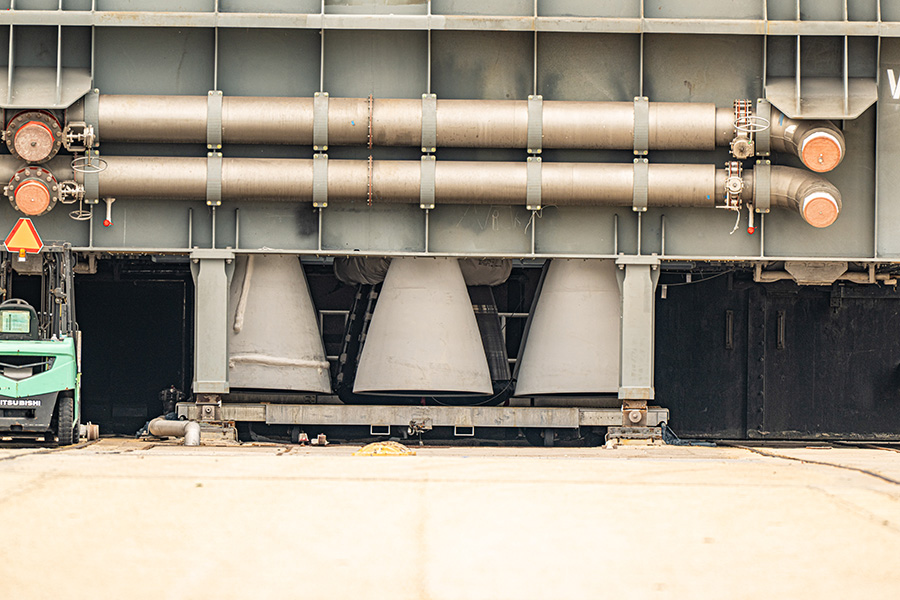
The stakes went beyond one launch. Vulcan has been grounded since February 12, when a booster nozzle burned through after liftoff on the USSF-87 national security mission — the second such nozzle failure in four flights. The payloads still reached orbit, but the Space Force paused Vulcan for military missions. "Until this anomaly is solved, we will not be launching Vulcan missions," Col. Eric Zarybnisky declared. Sunday's flight was the first for a redesigned nozzle; the investigation is still open.
So this is a commercial flight carrying a military verdict. The Space Force wants this flight done and its data reviewed before deciding whether to clear Vulcan for national security payloads again. "Every flight generates data and every flight teaches us something," ULA President and CEO Mark Peller said ahead of the launch — and the company wants this flight's data to prove its nozzle fix works in a real flight environment.
For Amazon, the flight opens a 38-launch campaign. Leo 1 carries the largest batch of Leo satellites yet — 40 of them — with Vulcan set to loft 1,500-plus across it. Amazon is already behind: Leo missed its FCC deadline for half its constellation in orbit by July 30, 2026, and flies on a waiver requiring completion by July 30, 2029. Once Sunday's satellites deploy — starting 70 minutes after liftoff, in 16 separation events — the constellation will number 432 satellites, still a fraction of Starlink's fleet.
What to watch: clean deployments, what the nozzle data shows, and how fast the Space Force moves on clearance. ULA already has the next Leo mission, LV-02, in processing. The rocket is back in the air — the question is how quickly it can stay there.
— via Florida Today